Northwest Colorado remains a hotspot for wolf activity in April
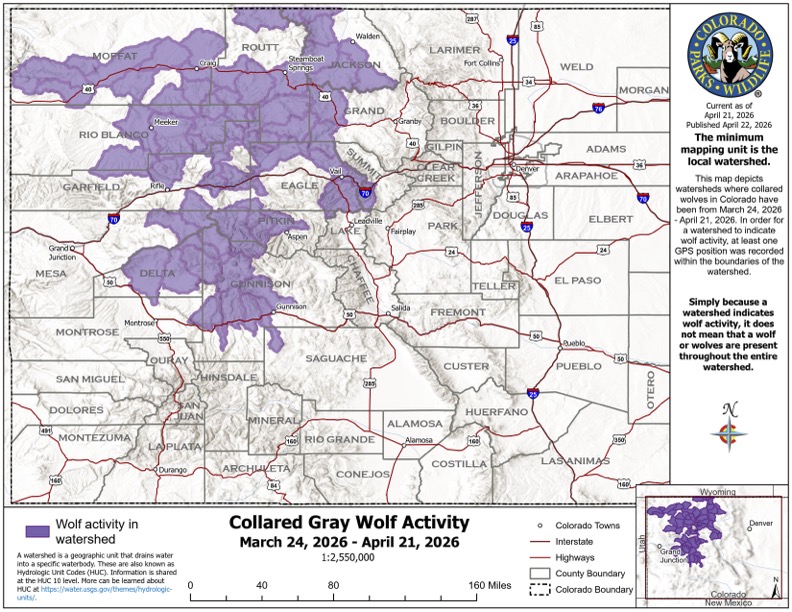
Colorado Parks and Wildlife’s wolf activity map shows wolves moving away from the New Mexico border and watersheds near the Front Range

Colorado Parks and Wildlife/Courtesy photo
Colorado’s collared gray wolves remained anchored in the state’s northwest corner as denning season peaks.
This is according to Colorado Parks and Wildlife’s most recent wolf activity map, which shows the watersheds where the state’s collared gray wolves were located between March 24 and April 21.
During this period, the wolves were located primarily in northwest Colorado watersheds across Moffat, Routt, Rio Blanco, Garfield, Eagle, Summit, Grand, Pitkin, Mesa and Jackson counties. There was also some activity in watersheds touching Delta, Gunnison, Montrose and Saguache counties toward the south.
While the April map showed similar northwest activity compared to the previous month, it showed the collared wolves pulling away from Front Range watersheds and does not show exploration along the Colorado-New Mexico border. In March, this southern movement came from one wolf, according to Parks and Wildlife.
If a watershed is highlighted, it means that at least one GPS point from one wolf was recorded in that watershed during the 30-day period. GPS points are recorded roughly every four hours.
Some of the watersheds highlighted in the April map reach Colorado’s borders with Utah and Wyoming. These maps only show wolf activity within the state of Colorado. Gray wolves that leave Colorado face different rules and protections depending on where they go.
Alongside the map’s publication, Colorado Parks and Wildlife reports that its staff continues to monitor four packs, all of which are located in northwest Colorado: the Copper Creek Pack in Pitkin County, the King Mountain Pack in Routt County, the One Ear Pack in Jackson County and the Three Creeks Pack in Rio Blanco County.

The wolves are currently in the midst of denning season, which typically begins in mid-March and can peak in April and May. Parks and Wildlife has not confirmed any additional dens or new pack formations this spring.
The wildlife agency continues to include the King Mountain pack in its count, despite both breeding adults dying this year. The pack had four pups. One of the pups was collared in January, during the same operations that resulted in the death of the pack’s patriarch. The matriarch died six weeks later.
In March, Luke Perkins, a public information officer for Parks and Wildlife, said it remained to be seen whether the pups would stay together or separate following both adult wolves’ deaths.
Almost two and a half years into Colorado’s voter-mandated reintroduction of gray wolves, the state has released 25 wolves from Oregon and British Columbia. Thirteen of these 25 wolves have died.
Of the 12 surviving reintroduced wolves, six are part of a breeding pair and pack. Eight are female and four are male. The four surviving wolves born to the Copper Creek pack in 2024 — three males and one female — have reportedly dispersed from their pack. This could mean there are at least 10 dispersing wolves in Colorado. These counts do not include the number of pups born in 2025, which Parks and Wildlife has said will be reported in the next annual wolf report. Last year, the annual report was released in June.

Support Local Journalism
Support Local Journalism
As a Summit Daily News reader, you make our work possible.
Summit Daily is embarking on a multiyear project to digitize its archives going back to 1989 and make them available to the public in partnership with the Colorado Historic Newspapers Collection. The full project is expected to cost about $165,000. All donations made in 2023 will go directly toward this project.
Every contribution, no matter the size, will make a difference.