Colorado transportation officials plan to use express lane tolls to fund Bustang’s $25 million shortfall — but on I-70 that money won’t be enough
The bus service’s West Line between Denver and Grand Junction is the most expensive of its 3 main lines, according to the Colorado Department of Transportation

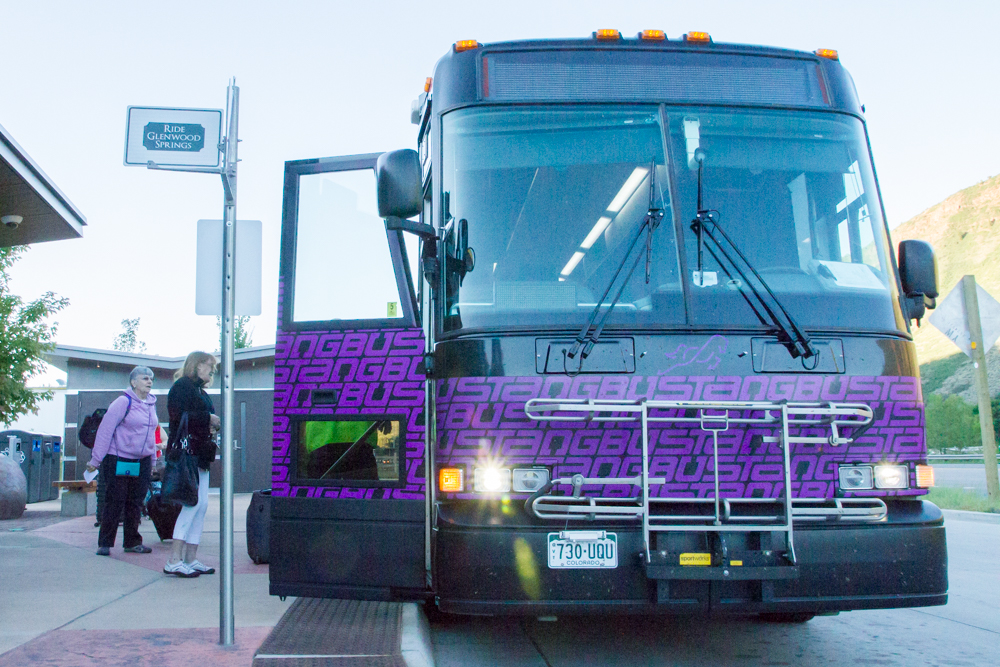
Aspen Times File photo
Colorado transportation officials plan to use toll revenues collected on interstates 25 and 70 to support the state’s popular Bustang bus service as they scramble to close a roughly $25 million annual deficit.
Colorado Department of Transportation Executive Director Shoshana Lew laid out the long-term funding plan, which keeps the money tied to the bus services on the interstate from which the tolls were collected, during a joint work session last week with the state’s Transportation Commission and Transportation Investment Office.
“We must — in a more constrained fiscal environment — chart a path forward to continue funding these important statewide transit routes at frequency, service levels and quality that can compete for riders’ demand,” Lew wrote in a letter to the two transportation entities. “This is a top priority for our team.”
Bustang offers three main lines: The North and South lines on I-25 and the West Line between Denver and Grand Junction on I-70. It also includes the Outrider service that connects rural areas to the larger bus system, Snowstang, which brings skiers from Denver to four mountains, and Pegasus, a faster shuttle-van option on I-70.
Ridership on the bus service has doubled in the past three years to more than 350,000 bus trips annually, according to the state transportation department. But, in February, officials told the Colorado Transportation Commission, which oversees CDOT’s budget, that state and federal funding that allowed the Bustang program to expand over the past few years would run out by July, leaving the program with an annual deficit of $25-35 million.
While the toll revenues are part of the long-term solution for Bustang, Lew said additional funding will have to be identified to support the I-70 West Line, and officials will continue to have to move money around to prop up the bus service in the short-term.
“The Bustang family of services provides vital connections across the state, standing out as a national model of success for interregional transit,” she said. “… The frequency and reliability that we have added in recent years make it a service that Coloradans can turn to as an additional choice for travel.”
Tolls wouldn’t cover all of I-70 West Line costs
The only tolls on I-70 and I-25 in Colorado are express lanes that give drivers “the choice of a more reliable trip” by paying a toll, according to the state transportation department. The I-70 Mountain Express Lanes from Idaho Springs to Empire cost between about $6 and $18 when they’re open during peak travel periods.
Lew said that state law allows for toll revenues to be used for bus services. While toll revenues collected on I-25 would cover the bus service there without impacting the region’s 10-year plan for capital projects, she said additional sources of funding will have to be identified on I-70, where Bustang is more expensive to operate.
“Our recommendation is … we be strategic about investing excess toll revenues in running the North and South lines along the I-25 corridor,” Lew said. “Then, focus on the (I-70) West Line with other revenues, including toll revenues but also other sources that we will need to continue working through over the next couple months.”
Lew said that the transportation department explored whether there would be support for a legislative change to allow toll revenues collected on I-25 to help fund Bustang operations on I-70 “that serve an overlapping user base.” However, she said that “such a change would generate significant consternation among I-25 partners in particular,” so the plan is to keep funds linked to the interstate on which they were collected.
Paul DeRocher, the director of CDOT’s division of transit and rail, explained that I-70 West Line is the most expensive of the Bustang services, due to the distance that the line covers and the 15 daily round-trips that it offers. While the I-25 North and South lines each cost about $6 million to run, he said the I-70 West Line costs roughly $23 million.
Lew wrote in her letter that officials will have to “seriously explore” moving Bustang operations to the Colorado Transportation Investment Office “to better align business functions with use of toll revenues as a significant funding source.”
The Colorado Transportation Investment Office is an independent, government-owned business within the transportation department with a legal responsibility to seek out means for financing transportation infrastructure projects in the state, according to the CDOT website. It operates and manages the state’s express lanes.
Transit officials to continue exploring short-term funding options
During its meeting on Friday, the Colorado Transportation Commission also unanimously approved a budget amendment to reallocate about $16 million in funding to help support the Bustang program in the upcoming fiscal year, which starts July 1.
DeRocher said that the reallocated funding includes about $12 million from the transportation department’s Innovative Mobility Program and about $4 million from the Congestion Mitigation and Air Quality funds. The transportation department expects to request another $2 million in air quality funds for Bustang during the next fiscal year, which he said will get the program within “striking distance” of the funding it needs.
After those reallocations, Bustang program remains about $7 million short in fiscal year 2027, DeRocher said. He said that the transportation department has several options to close that gap, including service optimizations, deferral of capital costs such as new buses, or allocation of transportation commission reserved funds.

Support Local Journalism
Support Local Journalism
As a Summit Daily News reader, you make our work possible.
Summit Daily is embarking on a multiyear project to digitize its archives going back to 1989 and make them available to the public in partnership with the Colorado Historic Newspapers Collection. The full project is expected to cost about $165,000. All donations made in 2023 will go directly toward this project.
Every contribution, no matter the size, will make a difference.