Colorado transportation officials plan to use express lane tolls to fund Bustang’s $25 million shortfall — but on I-70 that money won’t be enough

Colorado transportation officials plan to use toll revenues collected on interstates 25 and 70 to support the state’s popular Bustang bus service as they scramble to close a roughly $25 million annual deficit.

Colorado Department of Transportation Executive Director Shoshana Lew laid out the long-term funding plan, which keeps the money tied to the bus services on the interstate from which the tolls were collected, during a joint work session last week with the state’s Transportation Commission and Transportation Investment Office.

“We must — in a more constrained fiscal environment — chart a path forward to continue funding these important statewide transit routes at frequency, service levels and quality that can compete for riders’ demand,” Lew wrote in a letter to the two transportation entities. “This is a top priority for our team.”

Bustang offers three main lines: The North and South lines on I-25 and the West Line between Denver and Grand Junction on I-70. It also includes the Outrider service that connects rural areas to the larger bus system, Snowstang, which brings skiers from Denver to four mountains, and Pegasus, a faster shuttle-van option on I-70.

Ridership on the bus service has doubled in the past three years to more than 350,000 bus trips annually, according to the state transportation department. But, in February, officials told the Colorado Transportation Commission, which oversees CDOT’s budget, that state and federal funding that allowed the Bustang program to expand over the past few years would run out by July, leaving the program with an annual deficit of $25-35 million.

While the toll revenues are part of the long-term solution for Bustang, Lew said additional funding will have to be identified to support the I-70 West Line, and officials will continue to have to move money around to prop up the bus service in the short-term.

“The Bustang family of services provides vital connections across the state, standing out as a national model of success for interregional transit,” she said. “… The frequency and reliability that we have added in recent years make it a service that Coloradans can turn to as an additional choice for travel.”

Tolls wouldn’t cover all of I-70 West Line costs

The only tolls on I-70 and I-25 in Colorado are express lanes that give drivers “the choice of a more reliable trip” by paying a toll, according to the state transportation department. The I-70 Mountain Express Lanes from Idaho Springs to Empire cost between about $6 and $18 when they’re open during peak travel periods.

Lew said that state law allows for toll revenues to be used for bus services. While toll revenues collected on I-25 would cover the bus service there without impacting the region’s 10-year plan for capital projects, she said additional sources of funding will have to be identified on I-70, where Bustang is more expensive to operate.

“Our recommendation is … we be strategic about investing excess toll revenues in running the North and South lines along the I-25 corridor,” Lew said. “Then, focus on the (I-70) West Line with other revenues, including toll revenues but also other sources that we will need to continue working through over the next couple months.”

Lew said that the transportation department explored whether there would be support for a legislative change to allow toll revenues collected on I-25 to help fund Bustang operations on I-70 “that serve an overlapping user base.” However, she said that “such a change would generate significant consternation among I-25 partners in particular,” so the plan is to keep funds linked to the interstate on which they were collected.

Paul DeRocher, the director of CDOT’s division of transit and rail, explained that I-70 West Line is the most expensive of the Bustang services, due to the distance that the line covers and the 15 daily round-trips that it offers. While the I-25 North and South lines each cost about $6 million to run, he said the I-70 West Line costs roughly $23 million.

Lew wrote in her letter that officials will have to “seriously explore” moving Bustang operations to the Colorado Transportation Investment Office “to better align business functions with use of toll revenues as a significant funding source.” 

The Colorado Transportation Investment Office is an independent, government-owned business within the transportation department with a legal responsibility to seek out means for financing transportation infrastructure projects in the state, according to the CDOT website. It operates and manages the state’s express lanes.

Transit officials to continue exploring short-term funding options

During its meeting on Friday, the Colorado Transportation Commission also unanimously approved a budget amendment to reallocate about $16 million in funding to help support the Bustang program in the upcoming fiscal year, which starts July 1.

DeRocher said that the reallocated funding includes about $12 million from the transportation department’s Innovative Mobility Program and about $4 million from the Congestion Mitigation and Air Quality funds. The transportation department expects to request another $2 million in air quality funds for Bustang during the next fiscal year, which he said will get the program within “striking distance” of the funding it needs.

After those reallocations, Bustang program remains about $7 million short in fiscal year 2027, DeRocher said. He said that the transportation department has several options to close that gap, including service optimizations, deferral of capital costs such as new buses, or allocation of transportation commission reserved funds.

Major project to reshape Exit 203 in Frisco to begin next week, with goal of easing heavy Colorado mountain traffic

The Colorado Department of Transportation will begin work at one of Summit County’s busiest interchanges, Interstate 70 Exit 203, in Frisco on Monday, April 20. 

Contractor Zak Dirt and CDOT crews will work day and night shifts Monday through Saturday with occasional Sundays as needed, according to a news release sent by Austyn Dineen, Interstate 70 mountain corridor communications manager. Day shifts will be from 7 a.m. to 7 p.m. while night shifts will be 7 p.m. to 7 a.m.

The project aims to reduce traffic congestion, enhance safety features and add bicycle and pedestrian connections along Colorado Highway 9, Lusher Court and Dillon Dam Road at the north end of Frisco — an area that has long experienced heavy backups during peak travel times. 

In early May, CDOT has planned a short-term daytime detour on Dillon Dam Road to accommodate a sewer installation. Otherwise, CDOT plans to only close lanes on Highway 9 and Interstate 70 during nighttime hours — between 7 p.m. and 7 a.m. — to minimize impacts to daytime traffic. During the night shift, crews will place lane barriers and begin re-striping. 

No full road closures are anticipated during the first stage of construction, which is scheduled to end before November of this year. The second stage will likely commence in April 2027 following a winter shutdown. While CDOT has said impacts will be felt during both construction seasons, officials have indicated that 2027 will likely bring the most disruption as major roadway features are completed. 

Construction will occur in multiple phases, with work this year focusing on foundational elements, including work on the Interstate 70 bridge structure, retaining walls and part or all of a new Highway 9 underpass. Next year, crews are expected to complete the bridge and construct a new frontage road bypass under Highway 9 to link Dillon Dam Road and Lusher Court to further relieve traffic at the interchange just slightly to the north. 

The first phase of work also entails a short-term reconfiguration of traffic lanes along Highway 9 and the Interstate 70 exit ramps to allow roadwork to proceed safely. Additionally, CDOT plans to widen the Interstate 70 overpass and add a 10-foot-wide multi-use path to more safely accommodate cyclists and pedestrians traveling over the interstate. 

While exiting onto the I-70 westbound offramp for Exit 203 will remain a single lane, widening the offramp to two lanes should better hold traffic, according to Scott Harris, project manager with CDOT. Eventually, a traffic signal will be added to the I-70 westbound Exit 203 offramp in lieu of a roundabout. 

CDOT Executive Director Shoshana Lew wrote in a news release that the project to redesign the Interstate 70 mountain corridor, starting with Exit 203, has been in development for nearly five years.

Colorado Department of Transportation/Courtesy illustration
The Colorado Depatment of Transportation hosted an open house Wednesday, Oct. 25, 2023, where residents could learn more about the Interstate 70 Exit 203 Interchange Project.

“Breaking ground on the Exit 203 project marks a major milestone for the Interstate 70 mountain corridor, the primary thoroughfare to our popular mountain communities,” Lew wrote. “By enhancing multimodal access through regional services like Bustang and county-wide offerings like the Summit Stage, we are ensuring a safer, more efficient interchange for our local residents and the millions of visitors who travel through this gateway.” 

The Exit 203 interchange has long been identified as a chokepoint in Summit County’s transportation network, particularly during peak travel seasons when a larger volume of interstate traffic converges with local travel along Highway 9. The heavy traffic and congestion — driven both by daily commuters and vacationers heading to ski resort and recreation areas — frequently lead to back-ups on exit ramps and create safety concerns for drivers, cyclists and pedestrians. 

Transportation officials say the redesign will separate local and through traffic, reduce stop-and-go conditions and modernize infrastructure that has struggled to keep pace with growing demand. 

This rendering of Exit 203 demonstrates how the area will look different once construction is completed. The blue line represents the new route that will need to be taken by those exiting Dillon Dam Road on the Frisco side.

Construction will also address aging stormwater and utility infrastructure between Highway 9 and Dillon Dam Road. According to CDOT officials, the combination of traffic capacity improvements, expanded travel options and safety upgrades will better accommodate growth in both local populations and visitor numbers while reducing congestion at one of the county’s busiest gateways. 

Residents interested in learning more about CDOT’s planned construction near Frisco can access a project resource page at CODOT.gov/projects/i70-exit203-interchange-frisco, or sign up for project updates at Subscription.COtrip.org.

Here’s where CDOT expects construction to have traffic impacts on the I-70 mountain corridor as roadwork season kicks off

After a historically low-snow winter, the Colorado Department of Transportation is kicking off projects along the Interstate 70 mountain corridor as the construction season once again gets underway.

On I-70, continued work on  Floyd Hill and West Vail Pass will once again result in significant roadway impacts, including holds and shifts in traffic patterns, CDOT communications manager Austyn Dineen said in an email.

Other projects, such as the two-year project to build a new interchange at Exit 203 to Frisco or repairs to bridges through Glenwood Canyon, will also result in some less significant traffic impacts, such as delays and lane closures, Dineen said.

With the hot, dry conditions this past winter, she said the transportation department expects elevated fire danger this summer, so drivers should dispose of cigarette butts properly, secure any chains to prevent sparks and report any fires immediately.

Here’s a deeper look at how construction projects planned on I-70 will impact summer travel.

Floyd Hill

The three-phase Floyd Hill project will overhaul an 8-mile stretch of I-70 between Evergreen and Idaho Springs. The Colorado Department of Transportation discussed the Floyd Hill project and several other projects at a telephone town hall Monday, June 9, 2025.
Colorado Department of Transportation/Courtesy illustration

The I-70 Floyd Hill project is entering an “important, new phase of construction” as crews work to realign westbound I-70 from its current location to the hillside south of Clear Creek, according to the transportation department.

Located between Evergreen and Idaho Springs, the nearly 8-mile project began in 2023, with work expected to last through the end of 2029. The roughly $900 million project aims to widen the canyon, build new interstate bridges with gentler, safer curves and remove an existing bottleneck on westbound I-70 at the top of Floyd Hill.

Construction of a cast-in-place segmental bridge, which will carry the new westbound I-70 alignment, kicked off this spring and will continue through mid-2027, according to CDOT.

Crews on movable platforms will reportedly build the bridge above live traffic until the full span of the bridge connects.

Throughout the summer, drivers can expect temporary I-70 lane and ramp closures, traffic holds for rock blasting, new traffic patterns, narrowed lanes and shoulders and reduced speeds, Dineen said. Flaggers and alternating traffic will also be required this summer on U.S. Highway 40 near Floyd Hill.

The 20-minute holds for rock blasting are planned to occur Mondays through Thursdays from about 9 a.m. to 3 p.m. and between 9 a.m. and noon and Fridays, according to the transportation department.

Drivers can sign up for text alerts about the Floyd Hill Project by texting “floydhill” to 21000 or visit CODOT.gov/projects/i70floydhill for more information.

West Vail Pass

Construction advances on a new bridge along Interstate 70 near East Vail and Vail Pass. The new bridge is part of the West Vail Pass Auxiliary Lane Project that is expected to be completed in 2026.
Colorado Department of Transportation/Courtesy photo)

Now in its sixth — and final — year of planned construction, the West Vail Pass Project aims to bring a number of safety improvements to a roughly 10-mile stretch of I-70 with steep grades and tight curves.

This year, crews are planning to complete work on six wildlife crossings, an avalanche and rockfall mitigation system for the area known as The Narrows and resurfacing of westbound I-70. The work will also include landscaping and final improvements to the recreation path between the new bridges.

Beginning Monday, April 20, there is a possibility of daily single-lane closures along eastbound and westbound I-70 from Mile Post 180 to 190, according to the transportation department.

Starting in May, crews will shift I-70 traffic into a head-to-head, barrier-separated alignment in the new eastbound lanes to allow for roadway and wildlife underpass construction.

From early to mid-June, rock scaling is expected to require traffic holds from Monday to Thursday from about 9:30 a.m. to 2:30 p.m. each day.

From mid-June to early September, installation of the new avalanche and rockfall mitigation system will require occasional 20-minute traffic holds on I-70 in both directions. Only a few traffic hold days are anticipated.

Night work is possible anytime during the construction season, but is expected to become more consistent toward the end of the project.

The Vail Pass Recreation Path will remain open and accessible to riders and trail users through the season, with similar impacts to previous years. Intermittent trail holds for construction access may occur, and variable trail conditions could exist through construction areas. There 

are no anticipated extended recreational path holds scheduled this summer.

Drivers can sign up for text alerts about the Floyd Hill Project by texting “vailpass” to 21000 or visit CODOT.gov/projects/i70westvailauxiliarylanes/construction for more information.

Interchange construction at Exit 203 to Frisco

The Colorado Department of Transportation also plans to start construction on the I-70 Exit 203 Interchange Project in Frisco on Monday, April 20. This two-year project aims to reduce a dangerous backup that occurs on I-70 near Exit 203 as well as make other improvements for pedestrians and vehicles in the area.

Work will occur Monday through Saturday from 7 a.m. to 7 p.m., with occasional Sunday work as needed, according to the transportation department. No full closures are expected during the first season of construction, and during the day, two lanes of travel on I-70 will remain open. 

Nighttime lane shifts are planned on I-70 and Colorado Highway 9 from 7 p.m. to 7 a.m.

For more information on the project, call the project information line at 970-817-8647 or visit CODOT.gov/projects/i70-exit203-interchange-frisco.

Other projects with travel impacts

The Colorado Department of Transportation also has a number of other projects on I-70 that will result in fewer travel impacts this summer.

After work began last summer, the transportation department plans to wrap up the I-70 Glenwood Canyon Bridge Joint Improvement Project this fall. The project includes replacing 23 bridge joints and conducting other bridge repairs through the canyon. During weekdays this summer, the project will require single lane closures in both directions.

Between Exit 205 to Silverthorne and the Eisenhower-Johnson Memorial Tunnels, culvert repairs will require single-lane and shoulder closures in both directions.

From Exit 253 to Chief Hosa to Exit 262 to Morisson, drivers can expect a westbound lane shift with reduced shoulder and lane widths and single- and double-lane closures during the night, beginning in mid-July, according to CDOT.

I-70 reopens following 70-vehicle pile-up Tuesday evening

7:50 p.m.: Interstate 70 eastbound reopened after an hours-long closure due to a multiple vehicle incident earlier Tuesday evening.

Colorado State Patrol stated in a news release that the most current estimates show around 70 vehicles were involved in the incident, and 19 people were assessed for injuries. Eleven of them declined transportation, and eight were transported to area hospitals. One person had serious bodily injuries.

Westbound I-70 was briefly closed at the tunnels for an unrelated incident, according to the release, that involved a pickup truck and trailer that jack-knifed.

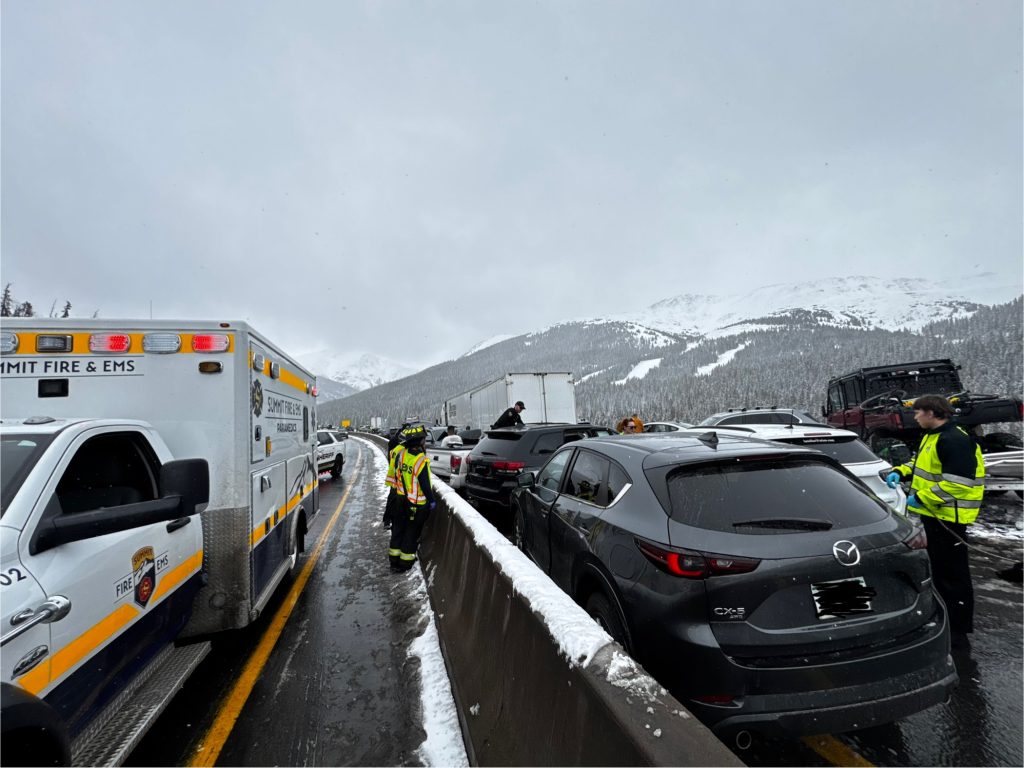
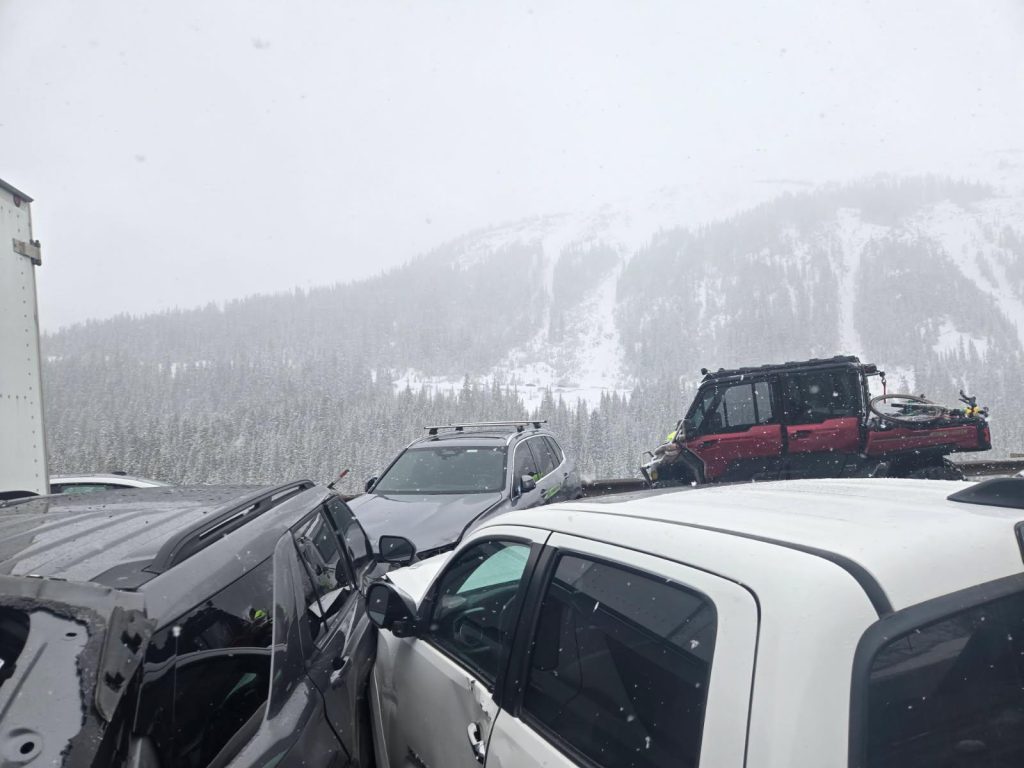
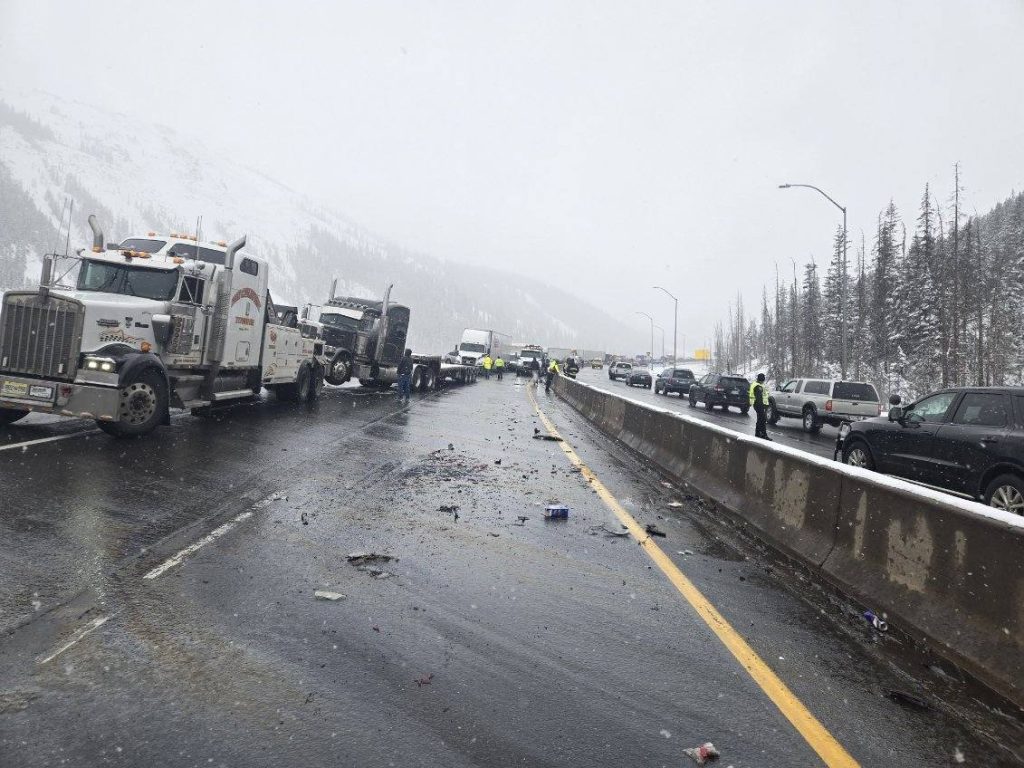
6:30 p.m.: Photos released by Colorado State Patrol show dozens of vehicles in a pile-up crash on Interstate 70 between the exit for Loveland Pass and the Eisenhower-Johnson Memorial Tunnels.

Eastbound I-70 drivers are being rerouted over Loveland Pass via U.S. Highway 6. Officials have not released an updated beyond the estimate for reopening happening between 8-10 p.m.

4:45 p.m.: Eastbound Interstate 70 is estimated to be closed for the next four to six hours, but one westbound lane has reopened while the left-most lane remains closed for medical staging following a multi-vehicle crash that occurred at 2:50 p.m. Tuesday, April 14, according to a Colorado State Patrol news release published at 4:48 p.m.

At least 19 people with various levels of injuries are being transported to a hospital, but no fatalities were reported. The Clear Creek Sheriff’s Office stated an estimated 75 vehicles were involved in the wreckage.

4:06 p.m.: On top of the full Interstate 70 closure near the Eisenhower-Johnson Memorial Tunnels, I-70 westbound is closed over Vail Pass for a crash.

4 p.m.: The Clear Creek Sheriff’s Office stated that the crash occurred on the on-ramp of eastbound Interstate 70, where traffic from U.S. Highway 6 merges into I-70. Deputies estimated more than 75 vehicles were involved, according to a social media post.

I-70 is still closed in both directions near mile marker 216 near the Eisenhower-Johnson Memorial Tunnels and is expected to be closed for “an extended period of time,” according to Colorado State Patrol.

Alternate routes are advised, and this story will be updated as more information is released.

3:50 p.m.: Both directions of travel on Interstate 70 near the Eisenhower-Johnson Memorial Tunnels are expected to be closed for “an extended period of time,” following a “large, multi-vehicle” crash, according to a Colorado State Patrol press release.

Alternative routes are advised.

The Clear Creek Sheriff’s Office estimated that more than 75 vehicles were involved in the crash that caused both directions of Interstate 70 to close for “an extended period of time,” according to the office’s social media post.
Clear Creek Sheriff’s Office/Courtesy photo

3:20 p.m.: A multi-vehicle crash has closed eastbound Interstate 70 through Colorado’s mountains following a multi-vehicle crash, according to COtrip.org.

The crash comes following numerous closures on Interstate 70 and other highways during a snowstorm that has brought a few inches of accumulation to valleys and icy conditions on mountain passes. There are more chances for snow later this week.

Traction and chain laws are in effect. For more information, visit CODOT.gov/travel/winter-driving/tractionlaw.

For the latest weather alerts, visit Weather.gov/bou. For traffic alerts and road conditions, visit COtrip.org.

Traffic backs up at the Eisenhower-Johnson Memorial Tunnels on April 14, 2026 following a multi-vehicle crash.
Colorado Department of Transportation/Courtesy photo

Silverthorne takes action at site of fatal pedestrian crash, 6th Street and Blue River Parkway, amid safety concerns and planning

A fatal pedestrian crash and ongoing safety complaints have prompted Silverthorne officials to plan improvements at the intersection of Sixth Street and Blue River Parkway.

“That corridor from Third (Street) all the way up to 10th Street has some safety concerns where vehicles meet pedestrians,” said Greg Camp, Silverthorne’s new town manager, at a Town Council meeting Thursday, April 8. 

Craig Phillips, a Silverthorne resident, read aloud a letter to council requesting the town restrict right turns on red or implement other safety measures to protect pedestrians and drivers at the intersection of Sixth Street and Blue River Parkway. 

“In my own experience driving through this area, making a right turn from Sixth Street onto Blue River Parkway often requires easing forward into the turn to see oncoming traffic,” Phillips said. 

Phillips added that oncoming traffic travels at a speed limit of 35 mph but said “there is a limited view of oncoming traffic from natural features and a slight bend in the road.” Located adjacent to the Blue River, the northern part of the intersection where Sixth Street meets Blue River Parkway is flanked by willows, pine trees and wooden fencing. Phillips said those natural features sometimes block visibility for drivers ready to turn right onto the four-lane parkway. 

“With these conditions present, it’s easy to focus primarily on vehicles and not immediately notice a pedestrian who may be crossing at the corner directly to the right,” Phillips said. “The visibility and reaction time feel limited, especially during busier times of the day.” 

On Jan. 10, a vehicle struck and killed 76-year-old Karen Rae Fox of Silverthorne, who was walking across Blue River Parkway via the crosswalk on the north side of the road’s intersection with Sixth Street. Max Gordon Miller, 46, was making a right turn from Sixth Street onto Blue River Parkway going northbound, according to a Silverthorne communications director. The Silverthorne Police Department subsequently charged Miller with careless driving resulting in death. 

Both Phillips and town officials referenced the fatal crash as evidence that the intersection needs added safety features to alert cars to incoming bicyclists and vice versa. Other Silverthorne residents have written letters to the editor since Fox’s death, requesting added safety measures to protect both drivers and pedestrians. 

“I know there was a tragic pedestrian fatality at this location, and it underscores how the challenges at this intersection can have serious consequences,” Phillips said. 

Mayor Ann-Marie Sandquist said the town has been communicating with the Colorado Department of Transportation regarding the intersection since January. She said CDOT has flagged it as a top priority since the fatality early this year. 

“I think, sadly, they’re paying more attention because there was a fatality there,” Sandquist said. “So it is getting attention, probably not as quick as all of us would want, but I would say it’s a priority for us as well.”

Camp said town parks staff already cut down some of the brush around the intersection early last week. While he said that work “substantially” improved visibility for drivers, there’s still work needed throughout the summer. 

“The willows were especially causing the most amount of impairment around that intersection,” Camp said, noting the trees have been trimmed. 

Additionally, Camp said he’s collaborating with CDOT, Town Engineer Deborah Snyder and Steven Herrman, parks, recreation, open space and trails director, to design upgrades at the intersection aimed to improve safety. While designs aren’t finalized, Camp said it remains a top priority as the town looks to upgrade the stretch of Blue River Parkway from Third Street to 10th Street. 

Phillips recommended the town consider:

  • Prohibiting right turns on red at all sides of the intersection
  • Adjusting signal timing to separate pedestrian and vehicle crossings
  • Enhancing signage or visibility at each crossing 

“I recognize that restricting right turns on red could create some added delay for drivers, myself included,” Phillips said. “But, I believe this may be a reasonable tradeoff if it improves the safety at this intersection.”

Camp said all suggestions are already under consideration, but the town hasn’t made any concrete decisions on how to redesign the intersection. Ultimately, CDOT has jurisdiction over the infrastructure at the intersection — the traffic lights, crosswalk and striping — while town parks staff is responsible for maintaining the surrounding land. 

Camp said he’s helping to finalize an application for a Safe Streets and Roads for All grant through the federal department of transportation in hopes that the funds could aid in improving Blue River Parkway. Camp said the grant is highly competitive, but the town remains committed to upgrading the Sixth Street intersection regardless. With additional seasonal workers arriving for the summer, Camp said work along the parkway will accelerate. Lane closures may eventually be needed to clear the way for parks or CDOT workers. 

“When the seasonal summer help comes in, (they’ll) start to work on the whole parkway, but obviously, I think Sixth Street and the intersection there has really been on everyone’s mind for several months now,” Camp said. 

Council member Bruce Butler said he considers it “dangerous” when bicycles approach the intersection from either direction. 

“They are right up on that crosswalk before you can really get a chance to see them,” Butler said. “If somebody comes out and they’re not ready to stop, there could be some really nasty, nasty wrecks there.” 

Butler suggested looking for ways to slow bicyclists as they approach the intersection with Sixth Street or provide motorists earlier indication when a biker or pedestrian is approaching. Council member Tanecia Spagnolia agreed with Butler that many bicyclists crossing Sixth Street to continue onto Blue River Parkway fail to assess whether incoming vehicles have fully stopped at the light. 

“You should make sure the car is going to stop before you cross that road, and people don’t,” Spagnolia said. 

Council member Jonnah Glassman requested Camp put together a project timeline so town officials can better communicate with the public about planned improvements and possible lane closures. Camp agreed to return to council with an updated schedule for cleanup efforts and construction along Blue River Parkway. 

“The work there is complicated only because it requires the cutting of the brush, getting it out of the river right-of-way and into the road right-of-way, which sometimes includes a lane closure,” Camp said. “We did want to make this area a priority.”

Traffic impacts expected on I-70 at Vail Pass this summer as auxiliary lane project enters final year of construction

Road work has begun on Interstate 70 as the West Vail Pass Auxiliary Lane Project enters its final season of planned construction, according to a news release from the Colorado Department of Transportation.

The construction, which resumed Monday, April 20, will result in various traffic impacts through about September. The West Vail Pass Auxiliary Lane Project began in 2021 with the goal of improving safety and operations along a roughly 10-mile stretch.

“As we enter the final season of this critical project, our focus is on a safe and successful project completion,” CDOT Executive Director Shoshona Lew said in a statement. ” … Every element of this work will make Vail Pass more resilient, reduce crashes and closures and provide a more reliable and enjoyable trip for everyone traveling on the I-70 mountain corridor.”

This year, crews are planning to complete work on six wildlife crossings, an avalanche and rockfall mitigation system for the area known as The Narrows, and resurfacing of westbound I-70, the release states. The work will also include landscaping and final improvements to the recreation path between the new bridges.

The best way to stay up to date with the project is to sign up for text alerts by texting “vailpass” to 21000, according to the transportation department. There is also a project information line at 970-688-8233 and weekly project updates available at Subscription.COTrip.org

How construction could impact traffic flow

Beginning April 20, there is a possibility of daily single-lane closures along eastbound and westbound I-70 from Mile Post 180 to 190, according to the news release. 

Starting in May, crews will shift I-70 traffic into a head-to-head, barrier-separated alignment in the new eastbound lanes to allow for roadway and wildlife underpass construction.

From early to mid-June, rock scaling is expected to require traffic holds Mondays through Thursdays from about 9:30 a.m. to 2:30 p.m. each day.

From mid-June to early September installation of the new avalanche and rockfall mitigation system will require occasional 20-minute traffic holds on I-70 in both directions. Only a few traffic hold days are anticipated.

Night work is possible anytime during the construction season, but is expected to become more consistent from the summer through the end of the project.

The Vail Pass Recreation Path will remain open and accessible to riders and trail users through the season, with similar impacts to previous years. Intermittent trail holds for construction access may occur, and variable trail conditions could exist through construction areas. There are no anticipated extended recreation path holds scheduled this summer.

To date, the transportation department has completed work on two new bridges, which are designed to last 100 years and offer improved curve geometry, a new 2.7 mile eastbound auxiliary lane designed to separate slow-moving commercial vehicles from passenger traffic and reconstruction of nearly two miles of the rec path It has also laid five miles of fiber-optic, dug new drainage to protect Gore Creek, expanded a U.S. Forest Service parking lot and resurfaced about six miles of roadway.

Colorado transportation officials update COTrip app with push notifications, new language features

The Colorado Department of Transportation has updated COTrip with new language options and push notifications.

COTrip is a smartphone app and online tool that state officials use to communicate closures, road conditions and other traffic information to Colorado drivers. The COTrip Planner App is available on the Apple and Android app stores and the online version can be accessed at COTrip.org.

COTrip.org now offers three languages: English, Spanish and Vietnamese, according to a news release from the transportation department. The language options were chosen based on the state’s demographics according to 2020 census data, the release states.

The language options are available on both the COTrip.org landing page as well as directly on the interactive map. A new language button is located in the upper-right corner of the map, according to the news release.

With the latest update, the COTrip Planner App for mobile devices can now support push notifications, the release states. Users can opt-in to receive push notifications by logging into their MyCOTrip account and editing the existing text and email alert options, according to the transportation department.

To help users set up notifications, which can be set up to notify them of closures or other alerts on specific roads, such as Interstate 70, CDOT created a how-to video available at tinyurl.com/HowToCOTrip

Colorado has a hands-free law that restricts drivers from using their phone while operating a vehicle, so state transportation officials ask that drivers review travel information before leaving or while pulled over safely on the side of the road.

Dillon Dam Road closed for maintenance

Dillon Dam Road closed at 8 a.m. April 8 for annual maintenance, according to the Summit County Government’s social media.

The maintenance work includes the clearing of rock and sand from the road and the recreation path along it. The county’s post stated the maintenance marks the end of the seasonal recreation path closure but reminds path users that “winter can show up again any time,” so they should obey posted signs and closures to stay safe.

The road is scheduled to reopen April 8 at 1 p.m.

Denver company Helios Charging to install seven fast-chargers for electric vehicles in Breckenridge

Editor’s note: This story was updated to correct that Teddy Wilkinson made the presentation to Breckenridge Town Council.

Thanks to a state grant and partnership with Helios Charging, by the end of 2027 the town of Breckenridge will have seven new fast-charge stations for electric vehicles. 

But the town still needs to decide where to put them. 

Teddy Wilkinson, the town’s sustainability and alternative transportation administrator, said installation and maintenance of the EV chargers comes at no cost to the town. 

Wilkinson said Helios Charging, a clean energy and EV charging developer based in Denver, requested to collaborate with the town on a state grant application to secure funding for new charging stations. The town provided a letter of support and earlier this year, the Colorado Energy Office awarded Helios with an over-$800,000 grant. Wilkinson estimated the overall project in Breckenridge to cost around $1.2 million but said Helios is covering all extra costs. 

The only request, Wilkinson said, is for the council to approve revocable site license agreements with Helios to formally hand over the use of seven parking spots. The grant stipulates the chargers must be installed within two years and remain in place for a minimum of five years. 

Wilkinson said last month he met with town engineering, parking and sustainability staff to deliberate ideal locations. He asked whether council preferred the EV chargers be placed at the Wellington lot at 203 N. Main St. or at the ice rink lot at 189 Boreas Pass Road.

Citing already tight local parking space, Mayor Kelly Owens and members of the town council all requested Wilkinson return with alternate options and a more in-depth analysis of possible parking impact on residents, visitors and local businesses. 

“I’d like to know how staff feels about losing that number of spaces in the Wellington lot,” Owens said. “Maybe something not in the center of town would be useful.”

Owens suggested looking at placing the EV chargers at the Gold Run Nordic Center or golf course lots. She said several other projects over the last couple years have already encroached on parking space at the Wellington lot, including the recent construction of a nearby pedestrian pathway. 

Helios will install Level 3 EV chargers, which provide rapid charging in around 20 minutes or less, Wilkinson said. 

Council member Jay Beckerman asked whether the chargers are intended primarily for longer-term residents and visitors or drivers passing the community. Wilkinson said the chargers would benefit both groups.

For residents without EV chargers at their homes, Wilkinson said, “it does provide a nice option for them where they could still purchase an EV and have additional infrastructure in town that they could use for charging.” 

For those just passing through town, he added, “it’s nice to be able to top off your charge in 20 minutes or less and make your way back.”

Beckerman said he shared the mayor’s concerns about potentially losing seven parking spots in either the Wellington lot or the ice rink lot.

“We already have so many uses happening with skier part-day parking, with overnight parking, with the ice rink, with the troll (statue), that I feel like it’s a difficult place to jam another use in,” Beckerman said. 

Parking availability has been a point of contention in Breckenridge over the last year. After hearing a slew of concerns from residents between November and January, the council opted not to move forward with a proposed 110-unit parking lot expansion for overnight users at the Gold Run Nordic Center. Local lodging industry members voiced criticism that the nordic center’s distance from downtown — around a 10-minute drive — would dissuade visitors from using it. 

“We quickly realized there is no perfect location to put these and lose the seven parking spaces,” Wilkinson said of planning a site for the new EV chargers. 

If council ultimately opts for the Wellington lot, Wilkinson said he’d anticipate some community resistance but would hope the distance between the chargers and the nearby South Gondola parking garage would lessen possible competition for parking spots. 

“I do think there’d be some people that will not be happy with losing additional spaces out of that lot,” Wilkinson said. “The parking structure is 100 yards away from, so I think it’s less of a loss of parking there.”

Beckerman requested that Wilkinson and Helios representatives also keep in mind effects to nearby local businesses when reviewing alternative site options. 

“It’s not that we’re like, don’t bring us back Wellington and ice rink, it’s more that we want to make sure we’ve vetted the situation,” Owens said at the end of the discussion. We’ll find a spot for them.”

CDOT begins work to install 66 new cameras, including on Loveland, Berthoud and Rabbit Ears passes

The Colorado Department of Transportation has kicked off a project to install 66 new cameras across the state, replacing some of the cameras it removed in rural mountain communities last summer.

The cameras will be put up over the next two years and will go live by fall 2027, according to a news release. The transportation department said the new camera infrastructure is part of a transition to a “state-owned, state-managed network designed for long-term reliability, cost savings and operational control.”

The current plans call for five new cameras on U.S. Highway 6 at Loveland Pass, one at U.S. Highway 9 and Heeney Road north of Silverthorne, one on Highway 9 in Blue River, five on U.S. Highway 40 at Berthoud Pass and three along Highway 40 at Rabbit Ears Pass.

The cameras will replace about 136 cameras, only about 90 of which were operational, that were taken down after its contract with a private company expired in July, CDOT Maintenance and Operations Communications Lead Stacia Sellers said.

Especially in mountain communities, residents often used the cameras to assess route conditions before heading out on the road. The transportation department said in the release that “public feedback was helpful in identifying where on the network customer utilization of cameras concentrates.” 

In some areas, where camera coverage was critical, including Berthoud Pass and Rabbit Ears Pass, the release states that the transportation department has placed solar powered cameras on existing infrastructure or placed cameras on portable trailers. Statewide, the transportation department operates more than 1,000 cameras, according to the news release.

A map showing where the new cameras are planned for installation is available at tinyurl.com/CDOTCameras