Jared Polis sets goal of cutting average home insurance costs by $800 annually by end of 2027
Colorado Gov. Jared Polis said he wants to reduce average homeowners insurance premiums by about $800 annually by the end of next year.
The goal, which Polis hopes to achieve through a mix of legislative and executive action, comes in response to a dramatic rise in homeowners insurance costs. Average premiums more than doubled between 2018 and 2023, and Colorado ranks as the sixth-costliest state for homeowners insurance, according to a Colorado State University report.
“It’s really unacceptable,” Polis said during a Thursday, April 23 press conference. “As we look at the cost of living and we talk about the cost of housing — of course it’s the cost of your rent and mortgage — but it’s also the cost of your homeowners insurance, and the premium increases in Colorado have simply been too high.”
Much of Polis’ plan is built on legislation that has already been passed to drive down insurance costs and provide a safety net to homeowners. That includes the Fair Access to Insurance Requirements, or FAIR Plan, which serves as an insurer of last resort that provides coverage for homes valued up to $750,000 for owners who can’t find insurance on the private market.
Another measure passed last year, House Bill 25-1182, requires more transparency from insurance carriers on how they assess a homeowner’s wildfire risk, with provisions aimed at ensuring homeowners receive discounted rates for mitigation work. That legislation goes into effect on July 1.
This year, lawmakers are also advancing Senate Bill 155, which is modeled after a 2025 bill that failed to pass. SB 155 seeks to raise up to $20 million per year for a grant fund that would help homeowners pay to install hail-resistant roofs, with the money coming from a 0.5% fee on insurance carriers’ plans. Carriers would be prohibited from passing that fee onto customers as a surcharge, according to the bill’s language.
Polis said focusing on hail is especially important for lowering insurance rates.
A study by the Colorado Division of Insurance released in February found that hail can account for anywhere from 26% to 54% of a premium’s costs, while wildfire accounts for as little as 0.9% to 24.6%.
Polis said his plan will also be achieved through administrative actions. That includes directing the state’s Division of Fire Prevention and Control to help local jurisdictions adopt wildfire resilience codes for new homes, bolstering fire detection, modeling and forecasting services, and making insurers more aware of Colorado’s mitigation efforts through data sharing.
Colorado Gov. Jared Polis holds a news conference with reporters following his final State of the State address on Jan. 15, 2026.
The high cost of home insurance is manifesting in all types of housing situations, Polis said.
In mountain resort areas, homeowners association fees for condominium complexes have exploded in recent years, driven largely by an increase in insurance premiums.
Colorado Insurance Commissioner Mike Conway said the legislation passed last year to address price transparency also applies to condominium complexes, not just single-family homes.
The legislation did not include penalties for insurers who don’t comply, but it does allow homeowners to appeal their risk assessment to their carrier. The state plans to launch an education campaign this summer to make homeowners aware of their rights under the new law.
Conway said insurers will also be required to file their models with the state and show that wildfire mitigation is being accounted for.
“We have a plethora of enforcement authority already in existing law,” Conway said.
Polis said if companies are not giving credit for mitigation efforts in their rates, he would direct the state’s insurance division to prevent those carriers from selling plans in Colorado. The insurance division has the ability to block companies from the market.
“If they’re being lazy or sloppy and not reducing the risk or adjusting it, that’s a problem,” Polis said. “They’d be given a chance to fix that, and hopefully they would, but at some point, if they’re not giving credit for improvements that are made to reduce risk, then they’re overcharging Colorado consumers.”
Polis is term-limited and will leave office at the beginning of 2027, meaning much of achieving his goal to lower rates could hinge on the actions of his successor. Polis said his plan would lay the groundwork for reducing premiums by the end of next year, and projected optimism that the next governor could work toward that goal.
“I can’t imagine the next governor would say, ‘I want to increase homeowners insurance,’ no matter who it is or what party they are,” Polis said.
Polis signs bill cutting licensing barriers for out-of-state teachers
Colorado Gov. Jared Polis signed Senate Bill 126 on April 20, along with several other bipartisan bills, after it passed the House in early April.
The bill eases requirements and speeds up the process for out-of-state educators to acquire their Colorado teaching license through the Interstate Teacher Mobility Compact. Enacted in 2023, the compact is an existing agreement among 13 states that allows Colorado to recognize and transfer professional teaching licenses held in other states without the need for additional exams or coursework.
Under existing law, licensed educators from other compact states must have at least three years of successful teaching experience within the last seven years to be eligible for a professional teaching license in Colorado. Senate Bill 126 removes the requirement that the experience must be within the previous seven years, expanding eligibility for qualified educators who have taken a break from the workforce for a variety of reasons.
“The seven-year requirement does create barriers for our Colorado workforce, especially in rural areas, where we’re trying to recruit from out of state,” Rep. Dusty Johnson, a Fort Morgan Republican and bill sponsor, said during a March hearing of the bill. “They could be nine years out, but they still have all the credentials and everything else our teachers need, and we would love to have them in our schools.”
The bill also requires the Colorado Department of Education to issue an initial teacher license to an educator licensed by a compact state within 30 days of receiving a complete application. Both provisions are especially beneficial to rural mountain districts, which face significant challenges to hiring like geography, cost of living and limited housing availability amid ongoing educator shortages.
“Our schools are struggling to fill teaching positions. The reasons our workforce challenges are many include low pay, heavy workloads and competition from neighboring states,” Johnson said during the hearing. “While there is no silver bullet to solve these problems, this bill is a small step to helping fill that void by expediting licensure for experienced out-of-state teachers.”
Although the Interstate Teacher Mobility Compact was enacted three years ago, states are still working to finalize the rules, meaning school districts have yet to feel the benefits.
Senate Bill 126 will go into effect in August 2026.
Housing lottery opening for first 19 units at Runway Neighborhood on Airport Road next month
The first 19 units in Breckenridge’s “last” large-scale workforce housing neighborhood development will soon be up for grabs via the county’s lottery system.
Summit Combined Housing Authority will open the lottery for the first 19 homes in the burgeoning Runway Neighborhood development from May 11-15, marking a key milestone in a multi-year buildout that is expected to deliver 81 workforce housing units by the end of 2028.
“This is the last big parcel that’s owned by the town of Breck and designated for workforce housing,” said Laurie Best, the town’s longtime housing director. “It’s an exciting time for the project and for the community.”
An open house on Wednesday, April 29, from 4:30-6:30 p.m. at the Breckenridge Recreation Center will give prospective buyers a chance to learn about the homes, meet project partners and prepare for the application process ahead of the five-day lottery window.
Summit Combined Housing Authority runs the lottery and expects to release initial results by May 19, Best said. Those who receive high lottery numbers will then move on to a more comprehensive qualification process that requires applicants to submit employment and income information.
Construction has been ongoing at the site off of Airport Road since August 2025. Best said crews have so far almost exclusively been working on underlying utility infrastructure like expanding water and sewer lines and paving roads. Actual homebuilding will ramp up this summer, with the first foundation slated to go up within the next month. Best said the first home could be “finished and ready for occupancy” by late December or early January if continued construction and the lottery process proceeds smoothly.
The Runway Neighborhood sits near the town’s other recent workforce housing development, Blue 52, north of the River Park area and represents the final neighborhood to be built on usable town-owned land. Best said the town has owned the 24-acre parcel for nearly 25 years.
“Runways is kind of just the build-out of that property that was acquired a long time ago,” Best said.
While the town is essentially “built out” in terms of developing larger neighborhoods to increase housing stock, Best said town leaders remain dedicated to finding future areas, albeit smaller, to build more diverse housing options for working Summit County residents.
“It’s a high priority for council to figure out how we can provide opportunities for people to live in the community where they work,” she said.
Best referred to the upcoming 19 units at Runway as “the first phase of the first phase” of housing construction. The entirety of the first phase, for which the town has pledged $34 million, entails 81 individual housing units. Best said those 81 homes will be built and sold in a series of four phases. Town officials have also discussed a future second phase of construction that would include an additional 67 units, but no decisions have been made yet.
All units will be reserved for people who maintain employment in Summit County. Most units will also come with income caps to prevent higher earners from competing for some of the town’s most subsidized units.
“They’re not intended to be for remote workers or people that need a ski house,” Best said.
The town partnered with Neighborhood Crafters, a Frisco-based developer led by Suzanne Allen Sabo, to develop the site. Sabo will be present at the open house on April 29.
In keeping with the town’s objective to provide diverse housing options for working residents, the first batch of 19 homes at Runway offers a range of options:
Six two-bedroom townhomes
Four three-bedroom townhomes
Two duplex units
One single-family cottage
Four three-bedroom single-family homes
Two four-bedroom single-family homes
Ratcheted down price points intended to cater to Summit County’s workforce
The town has framed the Runway Neighborhood as a major piece of Breckenridge’s long-term workforce housing strategy, with prices and eligibility requirements designed to prioritize the needs of low- to middle-income working families. Median home prices in Summit County sit over $2.2 million and continue to grow, outpacing salaries for many working families, according to the most recent market analysis from Land Title. Around 68% of the town’s housing stock is made up of second homes or vacation rentals, according to a countywide housing needs assessment completed in 2023. The study also found that around 60% of all renters, and 86% of Latino renters, spend over a third of their income on housing costs.
Some townhomes in the Runway Neighborhood will start at $351,000 and larger homes with more bedrooms will reach around $800,000. Best predicts the number of residents entering the housing lottery will continue to increase as the development gains more traction. Over the next two years, Best said there will be another three lotteries open for the rest of the houses built in the first phase.
“I know there most likely will be significantly more people interested in the units because of these price-points,” Best said. “We don’t want people panicking thinking this is their last chance to get into the lottery.”
Best said units in the Runway Neighborhood will be some of the lowest-priced homes for sale in Breckenridge.
“They’re our most affordable and deeply subsidized (properties),” Best said. “To get prices down to $351,000, that requires a lot of public investment.”
Best said the town has committed to spending $24 million on public utility infrastructure at the site. Town workers will later maintain the roads, water lines and other utilities in and around the neighborhood. Another $10 million will help close the gap between construction costs and attainable sales prices, while the developer covers all costs associated with building the homes. Best said around $5 million in state grants will further offset expenses.
“The town’s super fortunate because we do have a designated housing fund,” Best said. “A lot of communities that are struggling with workforce housing don’t have a local funding stream, and up here in the High Country where the cost of construction is so expensive, it’d be impossible to do any workforce projects without local funds.”
The town’s housing fund draws from a voter-approved sales tax adopted in 2006, which Best said generates around $7 million annually, coupled with short-term rental fees approved by voters in 2016 that bring in roughly $6.5 million each year.
Town aims to incentivize build-out of 20 ADUs
Best said the Runway project also includes long-term strategies that the town hopes will further expand housing supply.
The developer agreed to install 20 almost-ready accessory dwelling unit spaces above garages at single-family homes, hoping to incentivize owners to complete the interior of the units to rent out to locals.
While Breckenridge Town Council members previously requested fully building out 10 of the 20 accessory dwelling units, Best said that has since changed: all 20 units will have shells for accessory dwelling units with unfinished interiors.
“It’s basically ready for conversion to an ADU if the owner wants that,” Best said. “Ultimately it would be our goal that all of the 20 ADUs are eventually built out.”
Best noted that the town has partnered with Summit School District on the project and plans to offer a priority process for its employees — an effort aimed at helping more local educators find stable housing. Best said more details will be revealed at the open house April 29. The project developer, representatives from Summit Combined Housing Authority and the school district will also be present.
Before then, Best said, “The message for people right now is: if you think you are interested in buying, the very, very first thing you need to do is talk to a realtor and talk to a lender.”
Colorado Senate passes Western Slope lawmaker’s bill bolstering penalties for child sex crimes
A bill to increase penalties and expand criminal charges for sex crimes involving children cleared the Colorado Senate unanimously on Monday, April 20.
The measure, Senate Bill 15, is sponsored by Sens. Dylan Roberts, D-Frisco, and Byron Pelton, R-Sterling, as well as House Majority Leader Monica Duran, D-Wheat Ridge, and House Minority Leader Jarvis Caldwell, R-Colorado Springs.
Roberts, a former deputy district attorney for Eagle County, said cases of commercial sexual activity involving children are on the rise in Colorado.
A 2024 report by the Common Sense Institute, a Colorado-based think tank focused on free market enterprise, found that Colorado ranked 10th in the nation for human trafficking reports, with 84 incidents, based on FBI data. The report noted that virtually every U.S. state saw a spike in human trafficking reports during and after 2021.
Roberts, during a preliminary Senate vote on the bill last week, said crimes involving children are mostly committed against “young girls who are under the age of 18 by older men, mostly white and socially and economically advantaged, who purchase and solicit children for commercial sexual activity.”
Roberts added that Colorado already has laws against that type of activity, but added, “This is not what this (bill) is about. This is about making sure that the punishment for those crimes fits what I think most Coloradans would expect, which is prison time.”
He said state law provides a loophole for sex offenders to avoid prison or jail time by allowing a judge to grant probation to those convicted of a crime.
Sen. Dylan Roberts, D-Frisco, speaks on the Senate floor of the Colorado Capitol on Feb. 3, 2026.Robert Tann/Summit Daily News
SB 15 would require a person charged with soliciting commercial sex activity of a child to spend a minimum of 364 days in a county jail as a condition of receiving probation. The bill also mandates minimum sentencing requirements for other related crimes, including pandering, procurement and pimping of a child, and keeping a place for commercial sexual activity with a child.
Additionally, the bill makes internet luring of a child for commercial sexual activity a Class 3 felony, which can result in four to 12 years of prison time. Another provision of the bill changes “child prostitution” in existing law to “commercial sexual activity with a child.”
“This bill is so important because it is brought to us by victims and advocates,” Pelton said during last week’s preliminary vote. “They see the increase in child solicitations, and they want to go after demand. That’s what they’re going after with this bill.”
Other attempts to increase child sex crime penalties have failed
While the bill won unanimous approval from Senate lawmakers, measures seeking to outright remove the chance of probation for child sex crimes have failed at the Capitol in recent years.
The most recent attempt, Senate Bill 111, which would have removed the chance of probation for certain Class 3 and 4 felonies for child sexual assault, was killed in March by four Democrats on the Senate Judiciary Committee. Roberts was the only Democrat on the committee to join Republicans in voting to advance the measure.
Democrats who voted against the measure were largely concerned with mandatory sentencing requirements, which they said would remove the ability for judges to weigh the nuances of specific cases and could result in unintended consequences for victims. They also raised fiscal issues with the bill, which was projected to have cost $3.5 million due to increased incarcerations at a time when the state is grappling with a $1 billion-plus budget shortfall.
Sen. Nick Hinrichsen, D-Pueblo, was one of the four Democrats who voted against that measure, but supported the bill led by Roberts during its Senate Judiciary Committee hearing in February.
“I, as a matter of philosophical value, struggle with mandatory (sentencing) minimums because I think that judicial discretion is a critical part of due process,” Hinrichsen said at the time. “Yet this is so significant a space that I can absolutely get beyond that, and that’s not a barrier for me on this bill.”
SB 15 will now be considered in the House.
Breckenridge solidifying permitting and fees for e-delivery service downtown
Breckenridge Town Council approved a new permitting and fee structure for its voluntary e-delivery program, marking a transition from a pilot program to an ongoing local service aimed at reducing truck traffic in the downtown core.
The program, part of the broader Blue River Pathways Project, is designed to improve public safety, reduce traffic congestion and cut emissions by centralizing freight deliveries at a dock facility at 480 N. French St., just south of the City Market complex. From there, goods are transferred to smaller, low-speed electric carts operated by 106 West Logistics, which contracted with the town in November 2024, for the “last mile” of delivery.
Council unanimously approved an updated ordinance outlining the e-delivery permitting and fee process during a first reading Tuesday, April 14. A second reading and public hearing is slated for the council meeting April 28. Once adopted, the town plans to open applications for delivery permits in August and begin issuing them in October.
Jessie Burley, sustainability and parking manager, said the approach addresses longstanding challenges tied to Breckenridge’s downtown street layout.
“Our streets are narrow,” Burley said. “We are trying to encourage pedestrian walkability — mobility outside of cars and delivery trucks — in addition to the other traffic on Main Street.”
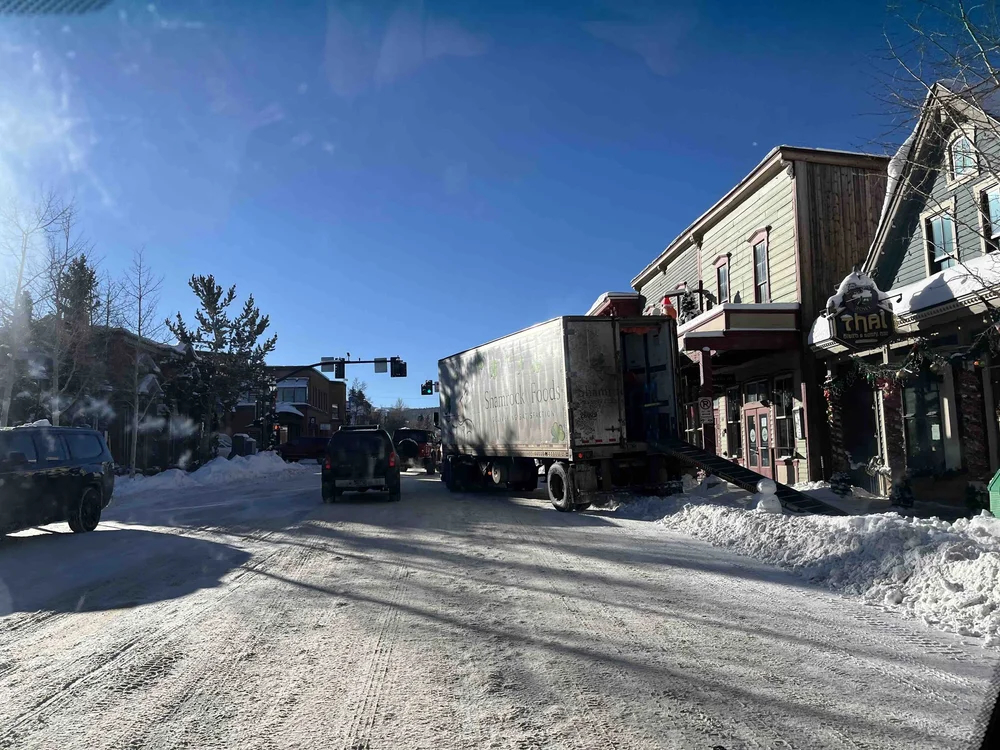
Burley pointed to a cluster of photos on a projector slide showing semis and large delivery vans stuck along the edges of snow-packed downtown streets.
Since launching the e-delivery pilot program a year and a half ago, Burley said, the downtown core has become much less congested with restaurant delivery vehicles.
“We have removed the delivery trucks off of the street, primarily to a centralized dock facility, and then we do the last mile of delivery in small, slow-speed vehicles with better visibility that can navigate our streets better,” Burley said.
A large food delivery truck obstructs traffic along a downtown Breckenridge street. The town’s e-delivery program has already removed around 2,500 large trucks from Breckenridge’s town core. Town of Breckenridge/Courtesy photo
Burley said the program aims to improve public safety by minimizing conflicts between large trucks, pedestrians and other vehicles, while also reducing truck idling times along Main Street. The need for such a system has grown more apparent in recent years, as Breckenridge’s historic streets — many originally laid out during its mining era — have struggled to accommodate increasing visitation and multiple modes of transportation. Especially during peak tourism periods, large delivery trucks operating in tight corridors can pose significant safety concerns, Burley said.
According to data compiled by Sustainable Breck, the e-delivery program has already removed over 2,495 large trucks from downtown streets, facilitated the delivery of over 482,000 products and provided more than 15,200 hours of curb space relief. Estimates also report a reduction of approximately 84,370 pounds of greenhouse gas emissions.
Council member Steve Gerard commended the program for aligning with several of the town’s long-term priorities.
“It really hits a lot of our goals with sustainability and clean air and safety issues,” Gerard said.
As the program becomes a more permanent fixture of Breckenridge’s transportation system, the updated ordinance establishes a permitting system and annual fees for distributors who choose to participate. While the use of the e-delivery system will remain voluntary, distributors who opt in will be required to obtain a permit and pay a fee based on their level of system use. (Distributors, rather than restaurants and bars, will have the opportunity to opt into or out of the program.)
Council landed on a tiered fee structure, with permit costs determined by factors like delivery frequency, number of locations served, unloading time and truck size. Larger distributors with greater operational impacts will pay higher fees.
At a work session March 23, town officials reviewed a point-based system that mimics 106 West’s first-of-its-kind e-delivery system in Vail. Compared to Vail’s model, though, Breckenridge’s policy includes an additional fifth tier at a 30% higher annual rate.
Each tier and assigned annual rate corresponds to the number of permit points logged:
Tier One: Fewer than six points, $3,900 per year
Tier Two: Six or seven points, $15,600 per year
Tier Three: Eight or nine points, $23,400 per year
Tier Four: 10 or 11 points, $35,100 per year
Tier Five: 12 or more points, $45,500 per year
The e-delivery program’s 2026 operating budget sits around $1.54 million, with only $175,000 currently budgeted in revenue. If all 17 distributors already participating in the program continue to do so under the proposed fee structure, the town anticipates generating over $295,000 annually, covering just under 20% of operating expenses.
Council member Jay Beckerman, also a local restaurateur, asked about outreach to local businesses, particularly restaurants that rely on frequent deliveries.
“Have you gotten anything out to the restaurant community to preempt some of the discussion that might be propagated by the vendors who want to try and do a PR campaign of their own?” Beckerman asked Burley.
Burley said she attended the most recent Breckenridge Restaurant Association meeting and based on feedback from members, she will soon be providing a document with frequently asked questions about the program to provide additional clarity.
Beckerman also asked whether enforcement of the e-delivery permit system would coincide with increased enforcement of designated delivery zones downtown. Burley confirmed that both will be enforced, but she noted that delivery zone permits fall under the town’s separate model traffic code.Burley added that in the fall — town budgeting season — the town may need to “increase the fees to cover the cost of enforcement and maintenance of” the existing delivery zone permit program.
Medicaid and SNAP are set for an overhaul. Colorado counties and lawmakers are wondering how to respond.
With major changes coming to the country’s social safety net system, Colorado counties are bracing for heavier caseloads and federal funding cuts.
Under the sprawling tax and spending law passed last summer by congressional Republicans, which President Donald Trump coined the One Big Beautiful Bill Act, states could be on the hook for hundreds of millions of dollars as they race to implement new eligibility requirements for Medicaid and the Supplemental Nutrition Assistance Program, or SNAP.
States will now have to reverify Medicaid eligibility twice per year, rather than annually, and ensure enrollees comply with new work requirements for Medicaid and SNAP.
Colorado is one of a handful of states that administer those programs at the county level. With some changes set to take effect next year, that’s likely to mean a heavier workload with “really extreme consequences for not doing it right,” said Kelly Flenniken, executive director for Colorado Counties, Inc.
“Counties are very worried, and they’re worried about it from several perspectives,” said Flenniken, whose organization represents all 64 of the state’s counties.
Flenniken said ensuring eligible people can stay enrolled in Medicaid and SNAP, while dealing with the increased paperwork and staff hours required to comply with the new federal rules, is a chief concern for county officials.
An estimated 377,000 Coloradans could lose Medicaid coverage, and nearly 300,000 could lose SNAP benefits, as a result of new work requirements and administrative burdens. The state projects that counties may need to double their number of Medicaid case managers, which would mean an additional 3,700 new staffers statewide. Yet many local governments are already struggling with tight budget environments.
It’s why Colorado lawmakers are eyeing a plan to consolidate some county-level health and human services operations, which they say could help alleviate stressors on local governments.
“How can we make the system more responsive and more effective and also more efficient?” said Sen. Judy Amabile, D-Boulder, who’s been working with other lawmakers on potential legislation to streamline how counties administer social programs.
A bill has yet to be introduced, but the legislature’s Joint Budget Committee, which Amabile sits on alongside five other lawmakers, has set aside a little over $3 million to fund such an effort in the next fiscal year’s budget, which starts on July 1.
Specifics are still being hashed out with county leaders, who initially voiced trepidation with some of lawmakers’ earlier ideas, including regionalizing human services departments, wherein one county would oversee social programs for multiple counties in a given region.
Some county leaders felt that would be too disruptive to the current process. They also raised concerns about taking autonomy away from other counties that administer those services.
“County systems are very good about serving people where they are,” said Summit County Commissioner Tamara Pogue, who’s part of a group negotiating with lawmakers on the potential legislation. “Particularly for folks in rural areas, having a human service office that you can go into and get help when you need it, where you need it, is ideal.”
Summit County Commissioner Tamara Pogue speaks about the impact the state’s budget challenges have on rural and resort communities during a rally outside the Colorado Capitol on March 17, 2026. Pogue said county health and human services departments have long struggled with staffing and funding issues, which she said will be exacerbated under federal changes to SNAP and Medicaid that were included in congressional Republicans’ tax and spending law. Robert Tann/Summit Daily News
Ideas have since shifted to focus more on streamlining existing services, though Pogue said there could still be ways to centralize some operations, such as training for health and human services staff.
One key area counties and lawmakers seem to agree on is updating the state’s benefit management system, which, while a state platform, is administered by each county. Pogue described the system as “very difficult,” adding that it “often takes years for (county technicians) to understand how to use the system without creating errors.”
That’s an issue that’s sure to take on new urgency as states deal with the changes under federal Republicans’ tax and spending law. In addition to shifting more of SNAP’s administrative costs to states, which could cost Colorado an additional $50 million annually, the law cuts federal funding from states with higher SNAP payment error rates starting next fall.
Pogue said even without the new federal changes, counties’ health and human services departments were already stressed due to a lack of sufficient state funding to administer social programs. She said her county discussed hiring more staff to deal with the increased workload from Republicans’ tax and spending law, but budget constraints mean “there’s no more money to pay for those employees.”
“How do you do more with less? That’s the question that we’re all wrestling with right now,” Pogue said.
While Pogue said the work to ratchet down Colorado’s error rate “has already started,” efforts to overhaul how counties deliver social programs will need to be a longer-term process.
“I think it’s very important that we not rush that conversation,” Pogue said. “That is the conversation that we need to make sure that we’re doing right so that we don’t have any unintended consequences as a result.”
As lawmakers and counties continue to negotiate the details of a forthcoming bill, both want to ensure that those who are eligible for benefit programs don’t fall through the cracks.
“That’s a big challenge,” Amabile said. “We have to keep doing what we’re doing while we make some changes. Things will have to run in parallel for a bit, and you have to have everybody bought in.”
Flenniken said a shared commitment to protecting enrollees is crucial to keeping negotiations on the proposed bill on track.
“Nobody wants to see penalties come. Nobody wants to see people going without the benefits that they need,” Flenniken said.
Former state rep mounts last-minute Republican primary challenge to U.S. Rep. Jeff Hurd in Colorado’s 3rd Congressional District
Republican U.S. Rep. Jeff Hurd is headed for a primary against former state Rep. Ron Hanks in his bid to hold onto his western Colorado congressional seat.
The development comes after Hanks, who served in the Colorado House from 2021 to early 2023, launched a last-minute campaign to secure a spot on the Republican primary ballot during the party’s state assembly in Pueblo. Hanks won enough support from party delegates during an April 10 voice vote, meaning he will challenge Hurd to be the Republican nominee for the 3rd Congressional District in the June 30 primary.
The 3rd Congressional District stretches from the northwestern corner of Colorado throughout most of the Western Slope and also swings east to include Pueblo.
Hurd and Hanks previously faced each other in the 2024 Republican primary to represent the district after U.S. Rep. Lauren Boebert, who had held the seat since 2021, abandoned her re-election bid to run for the 4th Congressional District in eastern Colorado.
Hurd went on to beat Hanks in the primary by a nearly 13-percentage-point margin before winning the general election against his Democratic opponent, former Aspen City Council member Adam Frisch, by 5%.
Hurd did not seek support from party delegates to secure a spot on the June primary ballot and instead gathered petition signatures to qualify.
“I respect the assembly process and the role that all of you play in it. That’s why I’m here,” Hurd told a crowd during the party’s assembly in Pueblo. “But I made my decision to get on the ballot by petition, and I’m confident in that path.”
A video posted on X shows several crowd members booing Hurd following his comments.
Hurd’s second major primary threat
Hanks is the latest Republican to mount a challenge to Hurd over what he sees as Hurd’s weak conservative policies and lack of loyalty to President Donald Trump.
“This is Conservative Colorado, Jeff. We support President Trump and America First … and you threatened (Donald Trump) you’d ruin it all,” Hanks wrote in an April 10 post on X. “(3rd District) voters will have your seat, Jeff. WE want to drain the swamp. You are part of it.”
Hurd previously faced a primary threat from Hope Scheppelman, a Navy veteran and a former vice chair of the Colorado Republican Party, who said Hurd is “dead set against President Trump and the millions of MAGA citizens like me who demand that Congress does the will of voters.”
Trump himself pulled his support from Hurd in February after the congressman joined a small group of House Republicans and nearly every Democrat in voting to oppose the president’s tariffs on Canada. Hurd said the tariffs were hurting agricultural and steel producers in his district.
In a reversal, Trump re-endorsed Hurd for re-election in March and convinced Scheppelman to drop her primary bid against him, saying he was giving her a position in his administration.
Asked last month how that would affect the race, a spokesperson for Hurd said, “Congressman Hurd is confident that the voters of (the 3rd Congressional District) will vote to re-elect him because he has consistently voted to put the district first.”
Hanks runs to Hurd’s right
Like Scheppelman, Hanks has pounced on Hurd’s legislative record.
While Hurd has supported much of the policy agenda of congressional Republicans and the Trump administration, including the GOP’s signature One Big Beautiful Bill Act, he has also broken with his party at times and worked with Democrats on issues ranging from public lands to health care.
Hanks called out Hurd’s support for a sweeping conservation bill, the Gunnison Outdoor Resource Protection, or GORP Act, which Hurd is co-sponsoring alongside Sens. Michael Bennet and John Hickenlooper. The measure would enhance federal protections for some 730,000 acres of Western Slope land across Gunnison, Saguache, Ouray, Hinsdale, Delta and Pitkin counties.
“NOBODY locks up the land tighter than the federal government,” Hanks wrote in an April 11 X post criticizing Hurd and the GORP Act. Lock It Up, and Watch It Burn.”
Hurd said he championed the bill because it has support from local communities, including several counties, municipalities, conservation and recreation groups, as well as the Ute Mountain Ute Tribe.
During an interview last year, he said his message on public lands during his campaign for Congress was to “make sure that we have federal lands management decisions that have the buy-in of the people that are affected by them.”
Hanks was in the spotlight at the beginning of his tenure as a state representative for attending Trump’s election denial speech in Washington on Jan. 6, 2021, which preceded the riot at the U.S. Capitol. He said at the time that he had marched with other Trump supporters to the Capitol and protested outside the building.
He has supported Trump’s false claim that he won the 2020 election against Joe Biden.
Asked by The Colorado Sun in 2024 whether they believed Biden was the winner of that election, Hanks said “no,” while Hurd said, “yes.”
On the Democratic side, two Aspen area candidates are running in the June primary to be the nominee to take on Hurd. They are businessman Alex Kelloff, the co-founder of Armada Skis, and Dwayne Romero, a former member of the Aspen City Council and Aspen School District Board of Education.
Silverthorne takes action at site of fatal pedestrian crash, 6th Street and Blue River Parkway, amid safety concerns and planning
A fatal pedestrian crash and ongoing safety complaints have prompted Silverthorne officials to plan improvements at the intersection of Sixth Street and Blue River Parkway.
“That corridor from Third (Street) all the way up to 10th Street has some safety concerns where vehicles meet pedestrians,” said Greg Camp, Silverthorne’s new town manager, at a Town Council meeting Thursday, April 8.
Craig Phillips, a Silverthorne resident, read aloud a letter to council requesting the town restrict right turns on red or implement other safety measures to protect pedestrians and drivers at the intersection of Sixth Street and Blue River Parkway.
“In my own experience driving through this area, making a right turn from Sixth Street onto Blue River Parkway often requires easing forward into the turn to see oncoming traffic,” Phillips said.
Phillips added that oncoming traffic travels at a speed limit of 35 mph but said “there is a limited view of oncoming traffic from natural features and a slight bend in the road.” Located adjacent to the Blue River, the northern part of the intersection where Sixth Street meets Blue River Parkway is flanked by willows, pine trees and wooden fencing. Phillips said those natural features sometimes block visibility for drivers ready to turn right onto the four-lane parkway.
“With these conditions present, it’s easy to focus primarily on vehicles and not immediately notice a pedestrian who may be crossing at the corner directly to the right,” Phillips said. “The visibility and reaction time feel limited, especially during busier times of the day.”
On Jan. 10, a vehicle struck and killed 76-year-old Karen Rae Fox of Silverthorne, who was walking across Blue River Parkway via the crosswalk on the north side of the road’s intersection with Sixth Street. Max Gordon Miller, 46, was making a right turn from Sixth Street onto Blue River Parkway going northbound, according to a Silverthorne communications director. The Silverthorne Police Department subsequently charged Miller with careless driving resulting in death.
Both Phillips and town officials referenced the fatal crash as evidence that the intersection needs added safety features to alert cars to incoming bicyclists and vice versa. Other Silverthorne residents have written letters to the editor since Fox’s death, requesting added safety measures to protect both drivers and pedestrians.
“I know there was a tragic pedestrian fatality at this location, and it underscores how the challenges at this intersection can have serious consequences,” Phillips said.
Mayor Ann-Marie Sandquist said the town has been communicating with the Colorado Department of Transportation regarding the intersection since January. She said CDOT has flagged it as a top priority since the fatality early this year.
“I think, sadly, they’re paying more attention because there was a fatality there,” Sandquist said. “So it is getting attention, probably not as quick as all of us would want, but I would say it’s a priority for us as well.”
Camp said town parks staff already cut down some of the brush around the intersection early last week. While he said that work “substantially” improved visibility for drivers, there’s still work needed throughout the summer.
“The willows were especially causing the most amount of impairment around that intersection,” Camp said, noting the trees have been trimmed.
Additionally, Camp said he’s collaborating with CDOT, Town Engineer Deborah Snyder and Steven Herrman, parks, recreation, open space and trails director, to design upgrades at the intersection aimed to improve safety. While designs aren’t finalized, Camp said it remains a top priority as the town looks to upgrade the stretch of Blue River Parkway from Third Street to 10th Street.
Phillips recommended the town consider:
Prohibiting right turns on red at all sides of the intersection
Adjusting signal timing to separate pedestrian and vehicle crossings
Enhancing signage or visibility at each crossing
“I recognize that restricting right turns on red could create some added delay for drivers, myself included,” Phillips said. “But, I believe this may be a reasonable tradeoff if it improves the safety at this intersection.”
Camp said all suggestions are already under consideration, but the town hasn’t made any concrete decisions on how to redesign the intersection. Ultimately, CDOT has jurisdiction over the infrastructure at the intersection — the traffic lights, crosswalk and striping — while town parks staff is responsible for maintaining the surrounding land.
Camp said he’s helping to finalize an application for a Safe Streets and Roads for All grant through the federal department of transportation in hopes that the funds could aid in improving Blue River Parkway. Camp said the grant is highly competitive, but the town remains committed to upgrading the Sixth Street intersection regardless. With additional seasonal workers arriving for the summer, Camp said work along the parkway will accelerate. Lane closures may eventually be needed to clear the way for parks or CDOT workers.
“When the seasonal summer help comes in, (they’ll) start to work on the whole parkway, but obviously, I think Sixth Street and the intersection there has really been on everyone’s mind for several months now,” Camp said.
Council member Bruce Butler said he considers it “dangerous” when bicycles approach the intersection from either direction.
“They are right up on that crosswalk before you can really get a chance to see them,” Butler said. “If somebody comes out and they’re not ready to stop, there could be some really nasty, nasty wrecks there.”
Butler suggested looking for ways to slow bicyclists as they approach the intersection with Sixth Street or provide motorists earlier indication when a biker or pedestrian is approaching. Council member Tanecia Spagnolia agreed with Butler that many bicyclists crossing Sixth Street to continue onto Blue River Parkway fail to assess whether incoming vehicles have fully stopped at the light.
“You should make sure the car is going to stop before you cross that road, and people don’t,” Spagnolia said.
Council member Jonnah Glassman requested Camp put together a project timeline so town officials can better communicate with the public about planned improvements and possible lane closures. Camp agreed to return to council with an updated schedule for cleanup efforts and construction along Blue River Parkway.
“The work there is complicated only because it requires the cutting of the brush, getting it out of the river right-of-way and into the road right-of-way, which sometimes includes a lane closure,” Camp said. “We did want to make this area a priority.”
Feds’ $140 million promised to Colorado River drought mitigation projects remains stuck for ‘bureaucratic’ reasons
Despite pressure from Colorado’s congressional delegation, around $140 million in federal funding previously granted to Western Slope water projects has lingered in limbo for nearly 16 months.
The funds, awarded to 17 Western Slope projects in the final days of President Joe Biden’s administration, were part of the Inflation Reduction Act’s drought mitigation grant opportunity for the Upper Colorado River Basin. This included $40 million granted to the Colorado River District to aid in its purchase of the Shoshone water rights, the oldest and largest non-consumptive right on the Colorado River tied to the hydropower plant in Glenwood Canyon.
Three days after the awards were announced, President Donald Trump took office, and his Day 1 order, “Unleashing American Energy,” called for all federal agencies to “immediately pause the disbursement of funds appropriated through the Inflation Reduction Act.”
In June, the U.S. Bureau of Reclamation released funds for two of the projects in the Orchard Mesa Irrigation District in Palisade, but the rest remain frozen.
“The funding has not yet been released, and that’s a real concern given current conditions across all of Colorado, but particularly western Colorado,” said Rep. Jeff Hurd, a Republican representing Colorado’s third district spanning the Western Slope, in an interview on Thursday, April 9. “I am continuing to press hard for clarity on timing and next steps because those projects were awarded for a reason and the need has not gone away.”
Since then, Hurd said he has been “actively working the issue at multiple levels.”
“I’ve raised it directly with the president. I’ve raised it directly with the acting commissioner of the Bureau of Reclamation, the Secretary of the Interior, the undersecretary at the Department of Interior,” he said. “My focus has been straightforward: These are projects that are tied to real water needs, and delaying them only increases the risk for communities not only in my district but throughout the Colorado River basin.”
Hurd said he remains hopeful the funds will be released, especially following what he referred to as a “productive discussion” with Trump.
“It’s gonna require continued pressure and attention,” he said. “There is broad recognition that water and water infrastructure and drought mitigation are not optional in the West, and these sorts of projects — for example, the Shoshone water right, and these other projects — they are practical. They’re targeted and they’re already vetted. So the case for moving forward on them is strong, and I’m gonna keep pushing until we see progress.”
With the funds frozen due to both “bureaucratic reasons” and “politics,” Hurd likened his approach to that of a river.
“I want to be like water when it comes to these obstacles,” he said. “When water meets an obstacle, it either goes around it or wears it down.”
Rep. Jeff Hurd, R-CO3, took the stage on Friday, Oct. 3, 2025 at the Colorado River District’s annual water seminar at Colorado Mesa University in Grand Junction.Ali Longwell/Summit Daily News archive
In an emailed statement, Rep. Joe Neguse, a Democrat representing Colorado’s second district, which spans portions of the northwest Front Range and a few Western Slope counties, said he was committed to pressing the Trump administration to release this “critical drought management funding,” with Hurd and Colorado Democratic Sens. Michael Bennet and John Hickenlooper.
“There is no more critical lifeline for our state, our communities, and our way of life here in Colorado than the Colorado River, and safeguarding this water source for future generations is an issue that impacts folks of every political stripe,” Neguse said. “This is of the utmost importance to farmers, ranchers, municipalities, conservation organizations, recreation businesses, county commissioners, and civic leaders across our state. And together, we’ll defend the Colorado River for the future of the state we all treasure.”
Which funds are withheld in Colorado
The Inflation Reduction Act set aside $4 billion toward drought mitigation, including funds for the Bureau of Reclamation’s Upper Colorado River Basin System Conservation and Efficiency program, also known as the Bucket 2E funding. In January, the Bureau under Biden’s administration allocated a total of $388.3 million to 42 projects on tribal land and in states in the Upper Basin.
This included $152 million for 17 projects in Colorado, including those for wildlife habitat, watershed and stream restoration, water infrastructure improvements and more.
Only $12 million of this funding for two Orchard Mesa Irrigation District projects — meant to improve water delivery to the 15-mile reach of the Colorado River, which extends from Grand Junction and the confluence of the Gunnison River and serves as critical habitat for several endangered fish species, as well as install new metering technology in the Grand Valley — has been released to the awardees.
The largest Colorado award was the $40 million promised to the River District, which represents 15 Western Slope counties. This funding represented a large chunk of the $98.5 million that the River District needs to purchase the Shoshone water rights from Excel Energy. Outside of the frozen federal dollars, the River District has raised $57.2 million from the state Legislature, its board and the various Western Slope municipalities and utilities it serves.
Matt Aboussie, Colorado River District’s communications director, said the district continues to work closely with the Bureau of Reclamation to secure this promised funding and remains committed to securing the rights.
“Funding will not be the obstacle that stops this effort,” Aboussie said. “If needed, River District leadership is prepared with alternative funding options and continues to rely on all our communities to get this project across the finish line.”
While the $40 million has been withheld, the Colorado River District has been going through all the other steps to acquire the water rights. In November, it entered into an instream flow agreement with the Colorado Water Conservation Board, which will ensure that flows tied to the water rights will remain in the Colorado River for environmental benefits regardless of the hydroelectric plant’s future.
The River District has also filed a joint application in water court with the conservation board and Xcel Energy. The water court will make the final determination on the acquisition, including rulings on some of the contested issues surrounding the district’s acquisition of the water rights, such as how much water has historically been granted. As this case gets underway, 63 entities have filed as parties with an interest in the acquisition, including Front Range water providers, cities and counties concerned about their transmountain diversions and around 23 Western Slope entities supporting the River District.
After a water court decree, the district will need funding and approval from the Colorado Public Utilities Commission to complete the transaction.
Funding needs intensify as drought worsens on the Western Slope
The entire state of Colorado is experiencing some degree of drought conditions as of April 7, 2026, according to the U.S. Drought Monitor. The most extreme conditions exist mostly in northwest Colorado, where historically low snowpack and high temperatures have water providers bracing for restrictions. U.S. Drought Monitor/Courtesy Photo
Colorado Gov. Jared Polis activated the state’s drought task force in March, which will help coordinate a response to the worsening conditions. Local water providers and municipalities are already introducing restrictions to guard limited water resources this summer. This has included declarations and drought restrictions across the Western Slope, including those from the Vail-area water district, the city of Steamboat Springs and the Mt. Werner Water and Sanitation District, Grand County and the towns of Basalt, Yampa, Frisco and Kremmling.
“These projects are about resilience. They are about liability. They help stretch limited water supplies. They improve storage and delivery systems and most importantly, they give communities in my district certainty and increasingly uncertain environment,” Hurd said.
The cost of a Colorado program providing health care to undocumented immigrants ballooned. Now, lawmakers are eyeing cuts.
When Colorado lawmakers passed a bill in 2022 to grant Medicaid coverage to pregnant immigrant women and children, regardless of their immigration status, they did so under the assumption that it would cost the state roughly $14.7 million in the program’s first full fiscal year.
In reality, Cover All Coloradans, which launched in 2025, will end up costing the state over $104.5 million for the fiscal year that began on July 1 and runs through June 30, a more than 600% increase over its original estimate.
Now, the program faces cuts as lawmakers prepare to close a roughly $1.5 billion shortfall in the upcoming state budget, including an enrollment cap and benefit reductions. It’s among a list of health care cuts proposed by the Joint Budget Committee, a bipartisan panel of lawmakers that crafts the state’s annual spending plan.
Colorado House Speaker Julie McCluskie, D-Dillon, who was a lead sponsor of the 2022 bill to create Cover All Coloradans, said she was “pained by the cuts” that were included in the budget committee’s spending plan, which the legislature will soon need to pass and send to Gov. Jared Polis to become law.
Still, McCluskie believes the proposals represent “responsible, if not very difficult, action” by budget writers.
“My hope is that we are able to continue to provide this program as best we can for years to come,” McCluskie said.
Colorado House Speaker Julie McCluskie, D-Dillon, speaks at the Capitol with reporters about Democrats’ agenda for the legislative session on Jan. 13, 2026. McCluskie was a lead sponsor of a bill in 2022 that extended Medicaid coverage to immigrants who are children and pregnant women, which is now facing cuts as lawmakers work to close a $1.5 billion budget shortfall. Robert Tann/Summit Daily News
For Republicans, the ballooning cost is a glaring example of what they’ve long argued: That Democrats have spent big on programs the state can no longer afford, which they say has contributed to the current budget crisis.
“We can’t afford to keep overspending on programs that are not core to our government, core to what we are supposed to be doing as legislators here at the state Capitol,” said Sen. Barbara Kirkmeyer, R-Brighton, one of two Republicans who sit on the budget committee, and a candidate for Colorado governor in 2026.
idas, said rollbacks to Cover All Coloradans will hit rural areas particularly hard. Mountain resort communities are home to large immigrant populations and already see some of the highest uninsured rates in the state.
Sanchez said less preventative care through programs like Cover All Coloradans will drive up expensive emergency services, like hospital visits and transfers.
“Colorado will have to learn the hard way that it will cost us more long-term by reducing proactive, preventive programs like the ones that we’re cutting now,” he said.
Miscalculations and incorrect assumptions
There are several factors behind why cost projections for Cover All Coloradans were so far off.
That includes an underestimation of how many new immigrants would come to Colorado and be eligible for coverage, according to the Colorado Department of Health Care Policy and Financing, which oversees the state’s Medicaid program.
The program only covers pregnant women and children under the age of 19 who don’t qualify for Medicaid because of their immigration status, including those who are undocumented. Originally, the program was expected to serve a few thousand people in its first year. But as of February, enrollment was around 28,000 people, about 20,000 of whom were children.
“This is a population that is very hard to estimate,” the department wrote in response to emailed questions. “Subsequent to the passage of the legislation, we had the largest migration into the U.S. since the late 19th century.”
Fiscal analysts also failed to accurately predict the cost of providing services to children, having assumed that they would be relatively healthier compared to the rest of the state’s Medicaid child population. Those assumptions were based on early data from a similar program in Oregon, but children enrolled in Cover All Coloradans ended up having similar costs to children on traditional Medicaid, according to the health department.
Colorado is one of 14 states that provide state-funded health care coverage to low-income immigrant children, and one of 24 states that cover pregnant women, regardless of their immigration status, according to the Kaiser Family Foundation.
The gold dome of the Colorado Capitol is pictured onJan. 15, 2026. Lawmakers are expected to pass the state’s 2026-27 budget within weeks, sending it to Gov. Jared Polis to become law.Robert Tann/Summit Daily News
To curb costs, the Joint Budget Committee approved a cap of 25,000 children for the 2026-27 fiscal year, which begins on July 1, and lowered the cut-off age from 19 years old to 18 years old. There would not be a cap for pregnant women.
The budget committee also included roughly $12.9 million in cuts for the program, recommended by the state’s Medicaid agency, including a cap on dental benefits and an end to long-term care services for new enrollees, though children currently receiving that care would be grandfathered in.
Some of the benefit cuts wouldn’t go into effect until Jan. 1, midway through the 2026-27 fiscal year.
Lawmakers are currently debating the budget, and will have the opportunity to bring amendments that the budget committee will either accept or reject. After that, the budget faces one more procedural vote in the House and Senate before it can be sent to Polis to become law.
‘A very serious value challenge’
The program’s future continues to divide lawmakers, with Democrats remaining committed in their support while some Republicans, who’ve largely opposed the program since its inception, want to see it end.
When making spending decisions, budget committee member Rep. Rick Taggart, R-Grand Junction, said the issue becomes more nuanced.
“I think it’s easy for people to take a position on one extreme versus another,” said Taggart, one of two Republicans on the Joint Budget Committee. “It’s a very serious value challenge to me.”
Taggart said he is sensitive to the argument made by many of his Republican colleagues that the program is providing state-funded health care to immigrants who may be undocumented, when that money could instead be going to Colorado citizens. Funding for children in the program comes from state dollars, although the state does use some federal funding to cover pregnant women.
Taggart said he has to balance that argument against two other factors.
“One is: These are human beings,” he said. “I can’t ignore that these are human beings, and when it comes to children, they didn’t make the decision to immigrate to our country; it was their parents.”
The other concern for Taggart is that if the program were eliminated, it would further stress hospitals, particularly in rural parts of the state, which would have to absorb more uncompensated care from immigrants who don’t have health coverage.
He said the cost-control measures the budget committee approved were “the best solution.” But the decisions haven’t been easy.
“I didn’t sleep,” Taggart said, “while I was trying to work this through in my mind: ‘What could we do that was fair to these families, but at the same time was fiscally responsible?'”
Cuts come after years of spending growth
The cuts being proposed by lawmakers this year have further fueled a debate over government spending.
A key driver of the state’s $1.5 billion shortfall is Medicaid, which recently eclipsed K-12 education as the single-largest budget item in the state’s general fund.
A state-commissioned report last year found that Medicaid spending had increased nearly 60% since fiscal year 2018. That’s almost double the rate of overall state spending growth allowed under the Taxpayer’s Bill of Rights, or TABOR, a 1992 voter-approved amendment to the Colorado Constitution that limits government revenue to the rate of population growth plus inflation.
Democrats have largely focused on the revenue cap as the reason for the budget shortfall, arguing that TABOR has artificially constrained the state’s ability to keep up with increased needs, such as more long-term care services for older Coloradans.
Republicans say money mismanagement and increased spending are the main culprits of the state’s budget woes. State Medicaid officials have come under scrutiny after recently revealing that they mistakenly overpaid certain providers for years, costing the state hundreds of millions of dollars. The state’s top Medicaid official, Kim Bimestefer, resigned this month amid criticisms of her handling of the health care agency.
And while increased utilization of expensive services, like long-term care, has driven up costs, lawmakers have also added hundreds of millions of dollars in increased expenses through the creation of new programs, like Cover All Coloradans.
Colorado lawmakers are pictured on the House floor inside the state Capitol on Aug. 25, 2025, during a special legislative session.Robert Tann/Summit Daily News
A February report by the Common Sense Institute, a think tank focused on promoting free enterprise policy, found that between 2019 and 2025, the Colorado legislature had enacted 182 new health care laws. Those measures, which the report says “created new bureaucracies, expanded covered services, and added regulations on public and private providers,” totaled at least $858 million per year in new state spending.
Now, lawmakers are preparing to vote on a budget that would pare back Medicaid spending across several areas, including a 2% cut to reimbursement rates for Medicaid providers, a cap on billable hours for at-home caregivers, and an increase to the waitlist for adults with developmental disabilities who need 24/7 care.
Kirkmeyer said an enrollment cap for Cover All Coloradans is a “good first step,” but feels that spending on the program has forced cuts to other essential services.
“I’m saddened by the fact that we have cut funding to those individuals who are the poorest of the poor that are among us and medically fragile and U.S. citizens,” she said.
McCluskie remained steadfast in her support for the Cover All Coloradans program, saying she still would have championed its passage in 2022 even if she had known then what its true costs would be.
“I have yet to talk to anyone who would say that a pregnant woman or a child is undeserving of care,” McCluskie said. “If we don’t provide this program upfront, then individuals … will wait until that child needs to be seen in an emergency room. The system is better for this program; overall, health care costs are better for this program.”
She added, “We have a lot of problems in the (health care) system, but fighting for this program is right.”