Breckenridge solidifying permitting and fees for e-delivery service downtown
Program for restaurant and bar distributors strives to reduce truck traffic, improve public safety
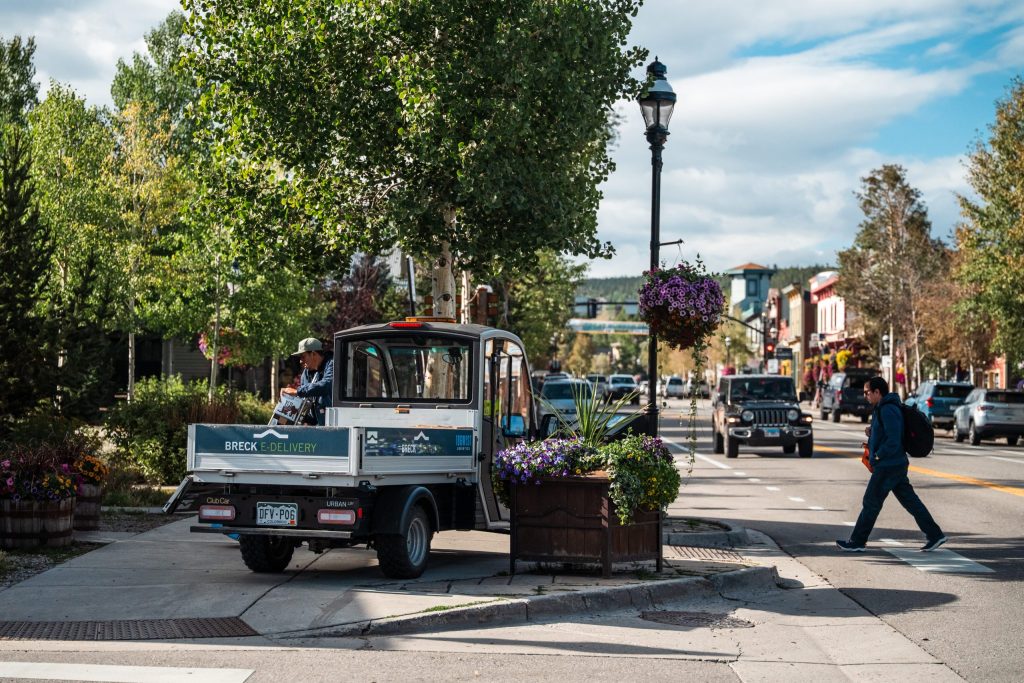
Breckenridge Town Council approved a new permitting and fee structure for its voluntary e-delivery program, marking a transition from a pilot program to an ongoing local service aimed at reducing truck traffic in the downtown core.
The program, part of the broader Blue River Pathways Project, is designed to improve public safety, reduce traffic congestion and cut emissions by centralizing freight deliveries at a dock facility at 480 N. French St., just south of the City Market complex. From there, goods are transferred to smaller, low-speed electric carts operated by 106 West Logistics, which contracted with the town in November 2024, for the “last mile” of delivery.
Council unanimously approved an updated ordinance outlining the e-delivery permitting and fee process during a first reading Tuesday, April 14. A second reading and public hearing is slated for the council meeting April 28. Once adopted, the town plans to open applications for delivery permits in August and begin issuing them in October.
Jessie Burley, sustainability and parking manager, said the approach addresses longstanding challenges tied to Breckenridge’s downtown street layout.
“Our streets are narrow,” Burley said. “We are trying to encourage pedestrian walkability — mobility outside of cars and delivery trucks — in addition to the other traffic on Main Street.”
Burley pointed to a cluster of photos on a projector slide showing semis and large delivery vans stuck along the edges of snow-packed downtown streets.
Since launching the e-delivery pilot program a year and a half ago, Burley said, the downtown core has become much less congested with restaurant delivery vehicles.
“We have removed the delivery trucks off of the street, primarily to a centralized dock facility, and then we do the last mile of delivery in small, slow-speed vehicles with better visibility that can navigate our streets better,” Burley said.
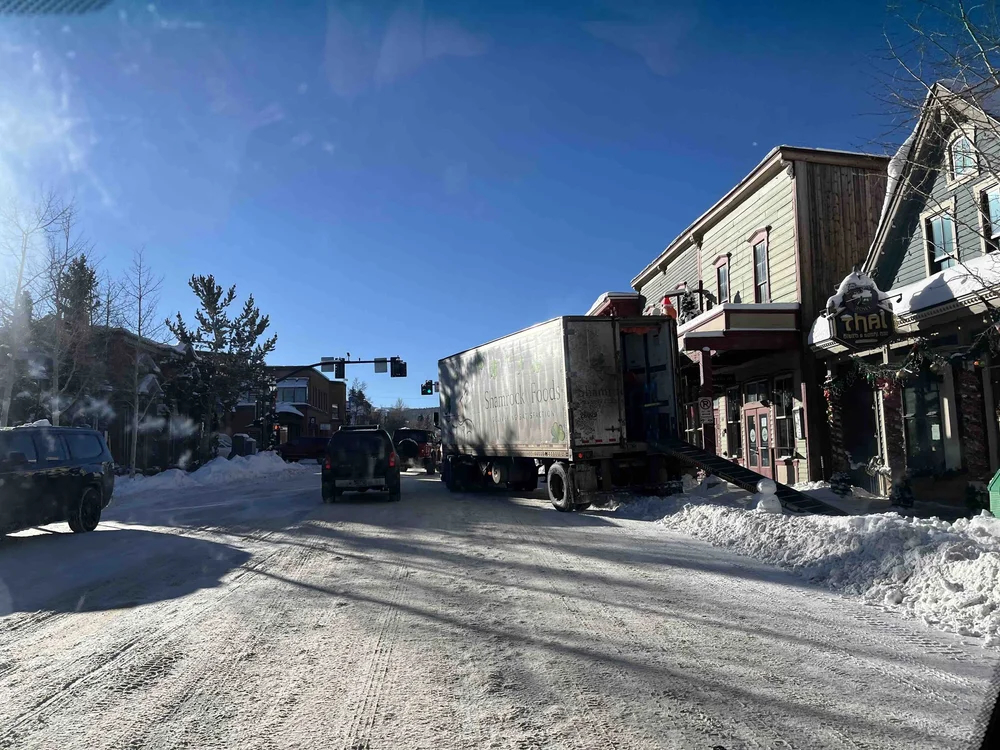
Burley said the program aims to improve public safety by minimizing conflicts between large trucks, pedestrians and other vehicles, while also reducing truck idling times along Main Street. The need for such a system has grown more apparent in recent years, as Breckenridge’s historic streets — many originally laid out during its mining era — have struggled to accommodate increasing visitation and multiple modes of transportation. Especially during peak tourism periods, large delivery trucks operating in tight corridors can pose significant safety concerns, Burley said.
According to data compiled by Sustainable Breck, the e-delivery program has already removed over 2,495 large trucks from downtown streets, facilitated the delivery of over 482,000 products and provided more than 15,200 hours of curb space relief. Estimates also report a reduction of approximately 84,370 pounds of greenhouse gas emissions.
Council member Steve Gerard commended the program for aligning with several of the town’s long-term priorities.
“It really hits a lot of our goals with sustainability and clean air and safety issues,” Gerard said.
As the program becomes a more permanent fixture of Breckenridge’s transportation system, the updated ordinance establishes a permitting system and annual fees for distributors who choose to participate. While the use of the e-delivery system will remain voluntary, distributors who opt in will be required to obtain a permit and pay a fee based on their level of system use. (Distributors, rather than restaurants and bars, will have the opportunity to opt into or out of the program.)
Council landed on a tiered fee structure, with permit costs determined by factors like delivery frequency, number of locations served, unloading time and truck size. Larger distributors with greater operational impacts will pay higher fees.
At a work session March 23, town officials reviewed a point-based system that mimics 106 West’s first-of-its-kind e-delivery system in Vail. Compared to Vail’s model, though, Breckenridge’s policy includes an additional fifth tier at a 30% higher annual rate.
Each tier and assigned annual rate corresponds to the number of permit points logged:
- Tier One: Fewer than six points, $3,900 per year
- Tier Two: Six or seven points, $15,600 per year
- Tier Three: Eight or nine points, $23,400 per year
- Tier Four: 10 or 11 points, $35,100 per year
- Tier Five: 12 or more points, $45,500 per year
The e-delivery program’s 2026 operating budget sits around $1.54 million, with only $175,000 currently budgeted in revenue. If all 17 distributors already participating in the program continue to do so under the proposed fee structure, the town anticipates generating over $295,000 annually, covering just under 20% of operating expenses.
Council member Jay Beckerman, also a local restaurateur, asked about outreach to local businesses, particularly restaurants that rely on frequent deliveries.
“Have you gotten anything out to the restaurant community to preempt some of the discussion that might be propagated by the vendors who want to try and do a PR campaign of their own?” Beckerman asked Burley.
Burley said she attended the most recent Breckenridge Restaurant Association meeting and based on feedback from members, she will soon be providing a document with frequently asked questions about the program to provide additional clarity.
Beckerman also asked whether enforcement of the e-delivery permit system would coincide with increased enforcement of designated delivery zones downtown. Burley confirmed that both will be enforced, but she noted that delivery zone permits fall under the town’s separate model traffic code.Burley added that in the fall — town budgeting season — the town may need to “increase the fees to cover the cost of enforcement and maintenance of” the existing delivery zone permit program.






Support Local Journalism
Support Local Journalism
As a Summit Daily News reader, you make our work possible.
Summit Daily is embarking on a multiyear project to digitize its archives going back to 1989 and make them available to the public in partnership with the Colorado Historic Newspapers Collection. The full project is expected to cost about $165,000. All donations made in 2023 will go directly toward this project.
Every contribution, no matter the size, will make a difference.